

The big item from last week’s Tucson City Council meeting that we didn’t get a chance to talk about during the election mayhem was a $4.2 million Department of Justice grant for patrol vehicles, motorcycles and a new mobile command unit.
Who doesn’t love free money from the feds?
Well, the Tucson City Attorney’s Office addressed the “problematic conditions” that come with accepting DOJ money in the Trump era.
Mainly, the City of Tucson is a party to four separate lawsuits against the Trump administration right now, challenging, among other things, some conditions attached to this exact grant.

Federal funding to buy a new mobile command unit similar to this SWAT vehicle comes with a lot of strings, apparently.
For example, the city doesn’t want to share law enforcement data with agencies like ICE.
The council voted 6-0 to take the federal dollars anyway, while rejecting some specific grant conditions imposed by the Trump administration’s DOJ.
Can they do that?
That’s up to the courts to decide.
Meanwhile, in a six-page economic development update to the council, the city identified manufacturing as one of its “Big Bets” and projected that Tucson could bring in as many as 2,350 manufacturing jobs over the next seven years.
Some of those will likely be tied to Raytheon’s planned expansion, but the city is also part of an effort to lure Taiwan-based companies to the region as it tries to cash in on new businesses associated with the massive semiconductor plant that Taiwan Semiconductor Manufacturing Co. is building in Phoenix. City officials argue other companies with ties to TSMC could set up shop in Southern Arizona.
And finally, while it wasn’t a big part of the actual meeting last week, council members plan to revisit their legislative priorities now that there’s a Democratic trifecta in state government.
We’ll know a little more next week about what big asks the council has for the Legislature.
Supervisors have a busy night
One of the biggest things we were hoping to see on the Pima County Board of Supervisors agenda for tonight’s meeting was Carmine DeBonis’ new contract to serve as the next county administrator.
Discussion of DeBonis’ contract is on the agenda, but the actual formal agreement is nowhere to be found — suggesting they are still hammering out the details of his six-figure contract two weeks after tapping him to be the county’s top bureaucrat.

There’s not a lot of good news in the early look at next year’s budget.
At the 1 p.m. study session before tonight’s meeting, supervisors will have their first discussion of the 2027-28 budget, including an update from outgoing County Administrator Jan Lesher. She penned a 40-page memo on the subject, outlining the preliminary county priorities.
The bigger discussion might be about this fiscal year, as unexpected cost overruns have whittled the county’s general fund contingency down to $2.8 million.
One thing that’s not on the agenda but may come up anyway is yesterday’s 73-25 U.S. Senate vote on the Bipartisan American Affordability and Jobs Act.
The legislation, if signed into law, would have some significant implications for Copper World since it would make it harder to sue to block projects on environmental grounds. A majority of the supervisors have done everything short of filing a lawsuit to stop the mine.
And one last thing: The county has scheduled a special meeting to sign off on the official canvass of the election on Thursday, November 19.
Want even more local coverage? Joe will be live-blogging from the meeting on our internal Slack channel, which we recently opened to subscribers, tomorrow at 1 p.m.

Trusting the Democrats and Elon: Democratic lawmakers and the governor claimed a massive victory against data centers when this year’s budget included a moratorium on tax incentives. But in the two weeks between passing that budget and when the moratorium kicked in, the state approved 107 applications for data center tax breaks (out of 113 applications filed), per the Republic’s Alaina Mencinger. In 2024, the state approved just 11 applications. Meanwhile, locals are not thrilled that Elon Musk’s SpaceX is attempting to build a supermassive data center in Cochise County, despite promises from the company that it will invest billions of dollars in the community, use zero water for cooling servers and lower residents’ electric bills by up to 40% because SpaceX would overpay for its electricity, the Herald/Review’s Mark Hays writes.
The victory lap: Gov. Katie Hobbs and her new Lt. Gov.-elect John Giles came to Tucson on Friday night to thank supporters after her double-digit victory over Republican Andy Biggs, per KGUN’s Craig Smith. She offered the usual hooray-for-the-team messaging while also pledging to work for the Republican voters who didn’t support her candidacy.

No to red-light cameras, yes to Flocks: The Town of Oro Valley is refusing to turn over public records about the information its license plate reader system has gathered about the five vehicles that local worker Leah Christopher owns, so she’s suing the town, alleging its internal policies to keep those records secret don’t comport with Arizona law, per KJZZ’s Matthew Casey. Meanwhile, Arizona voters last week approved Prop 319, which will restrict local governments from installing new traffic photo enforcement systems — though those are different from automated license plate readers like Flock cameras.
“It’s clear it’s not an Arizona requirement (to keep the records secret). It’s their own police requirement. And they’re choosing to just not be transparent about what they have,” Christopher said.
Don’t blame Pilar: Tucson Unified School District Governing Board candidate Pilar Acosta Ruiz narrowly knocked out incumbent school board member Val Romero in last week’s election, but considering the district is planning to vote in December on which schools to close and consolidate, Acosta Ruiz won’t really be part of the decision-making process, though she’ll have to help see those decisions through after she takes office in January, AZPM’s Noor Haghighi notes. And speaking of closures, TUSD Superintendent Gabriel Trujillo rolled back his recommendation that the district close Dunham Elementary, per the Star’s Sierra Blaser. The school has capacity for 350 students, but only had 137 students in the 2024-25 school year.
Same pecans, new owner: The giant pecan farm south of Tucson that’s owned by the Walden family is being sold to an undisclosed party, the Star’s Tony Davis reports in part one of a two-part series. Farmers Investment Co., owned by Richard “Dick” and Nan Walden, has been growing pecans in the area for more than 60 years, but the economics of farming the thirsty crop have pushed them out of the business. (The Walden family is also a regular contributor to Democratic campaigns and causes in Arizona, and Nan has been floated as a potential candidate for several offices over the years, though she’s never run.) The new buyer is something of a mystery, Davis writes, but company representatives said that the buyers are “pecan people.”

DeFlock Tucson is taking a public service approach in its fight to take down controversial license plate-reading cameras here in the Old Pueblo — by “adopting” a roadway.
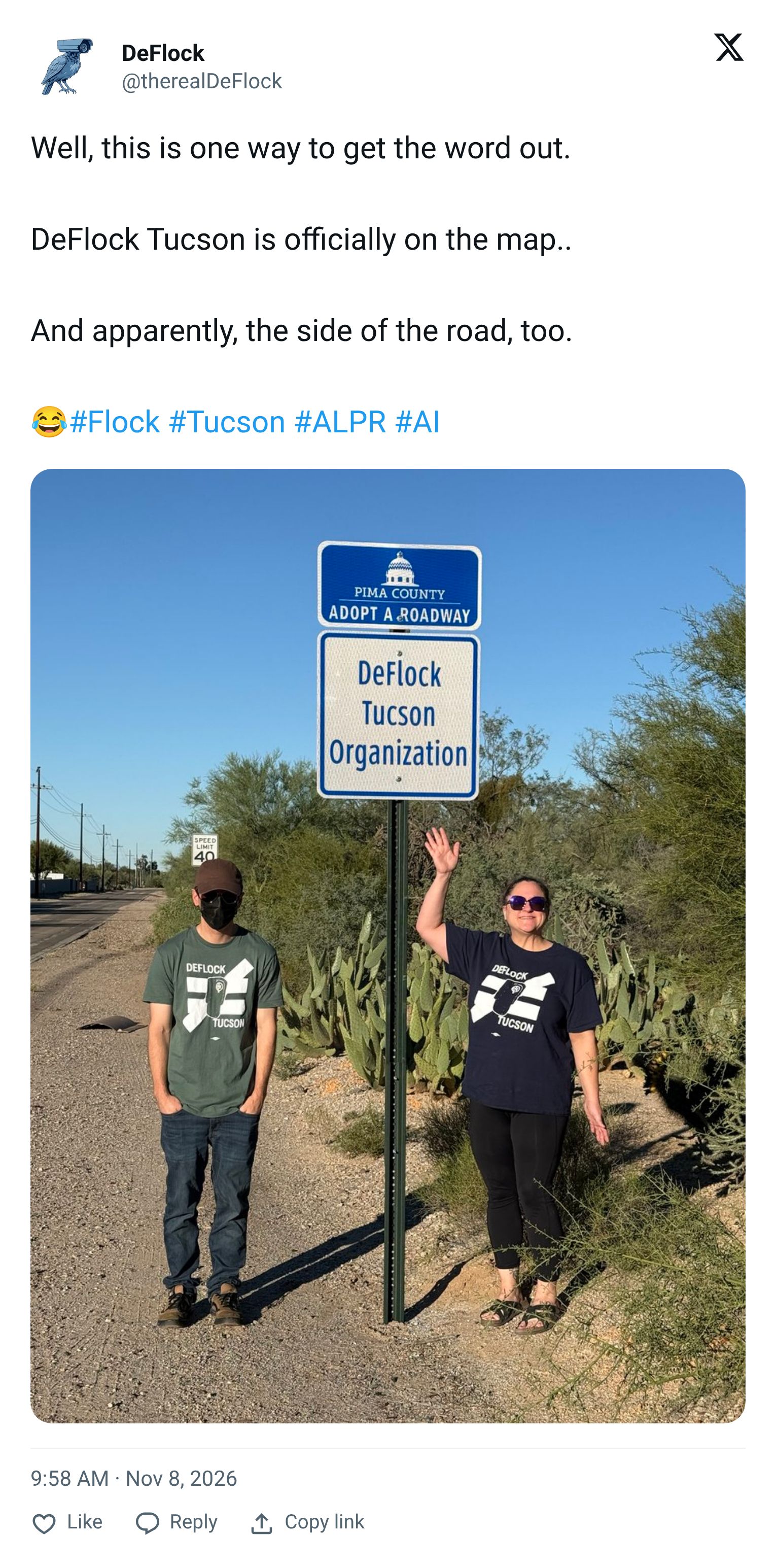
Turns out you can keep an eye on a roadway without recording everybody’s license plate.
The Flock Safety operated by local agencies have become controversial over the last few years, and locals have had some success in getting them taken down, most recently in South Tucson.
But anti-Flock advocates have a long way to go, according to their own map. The University of Arizona, for example, has more than 60 cameras on its main campus.
At least there will be a lot to talk about during their weekend cleanups of the roadway.