

Who is the real father?
Blue Owl is pulling the strings … New jaguar just dropped ... And why’d he get seated quickly?
First, Project Blue was supposedly going to bolt if anyone found out that the end user was Amazon Web Services.
Then the story shifted: Beale Infrastructure needed water from the City of Tucson to cool the data centers, which meant they’d have to be annexed into the city. But when the Tucson City Council refused, Project Blue announced it didn’t need the water — it would pivot to air-cooled data centers instead.
The developers also didn’t pack up their bags when Amazon quietly backed out — they just started talking to other potential end users — including Facebook/Meta — to step in instead.
Then Beale needed the Arizona Corporation Commission to approve its deal with Tucson Electric Power on Wednesday to move forward. (The commission approved the deal yesterday, despite nearly two hours of pleas from Tucson residents to kill the deal.)
And now, Beale says the land sale must go through by Christmas — or the $3.6 billion deal could be dead, or at the very least, part of a nasty court fight.
Even though they told the Arizona Corporation Commission they don’t have a contract with any future tenant.
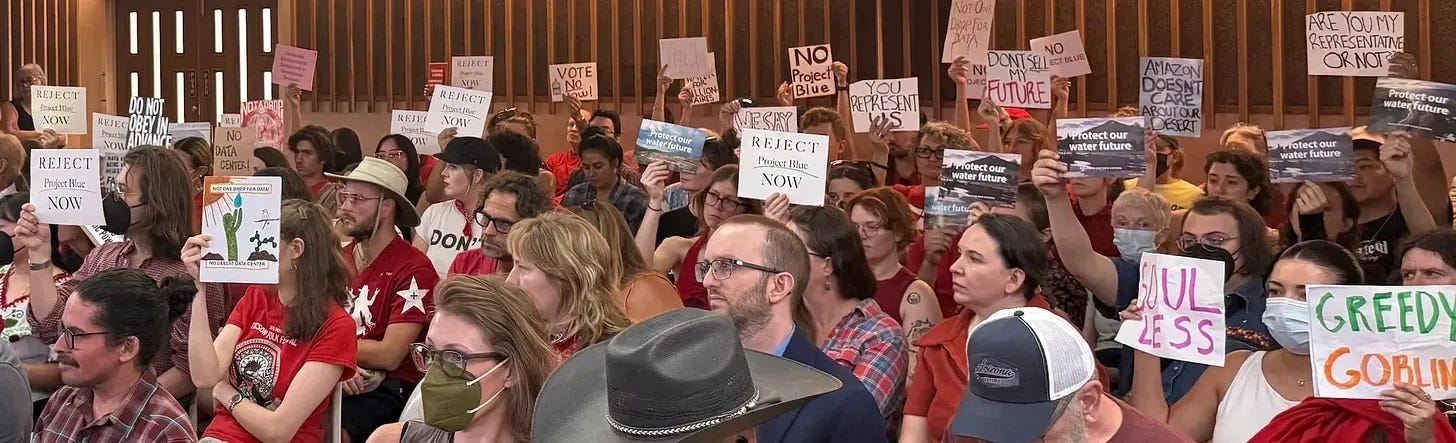
We’re not saying there aren’t obstacles ahead for the planned data centers — just that the big news this week that Amazon backed out isn’t the death knell some might have hoped it would be for the massive project.
Amazon, Meta, and any other rumored potential tech giants are simply future tenants inside the planned data centers.
There are still some pretty big issues hanging over Project Blue other than who wants to open up shop in Tucson, but we’ll circle back to that in a minute.
First, we need to explain who’s actually driving the project if it isn’t a specific tech giant — and why our ChatGPT-fueled speculation in June that STACK Infrastructure would run the data centers (rather than Amazon) wasn’t that far off the mark.
Technically, they still could be the group that manages the centers when (and if) they are built next the Pima County Fairgrounds.
Blue Owl is the common link
A lot of names have been tied to Project Blue over the last year.
Humphrey’s Peak LLC (which bought the land) and Beale Infrastructure (the developer) are the major players in the proposed development, and like we said earlier, we think STACK could still play a role once the data centers are built.
All three have one thing in common — they’re all tied to Blue Owl Capital, a massive “alternative asset” management company that, among other things, funds the construction of data centers.
Call it whatever you want — a hydra, an octopus, Russian nesting dolls — but they’re all companies under the umbrella of a firm listed on the New York Stock Exchange and valued at about $24.5 billion.
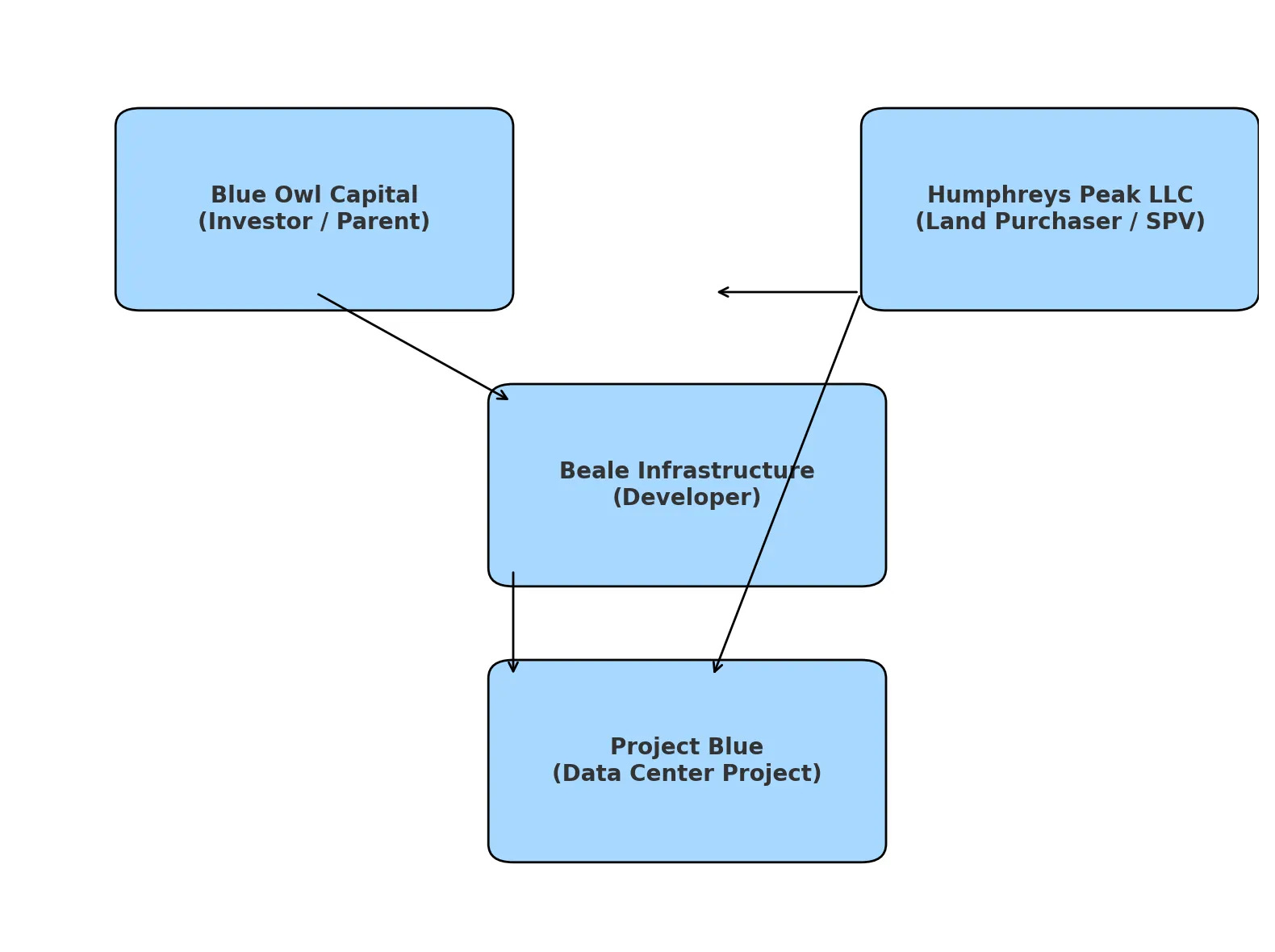
So Project Blue has never been funded directly by Amazon — and it won’t be funded by Meta either. Blue Owl sees an opportunity to collect their sweet, sweet cash in the form of monthly rental payments for the data centers they want to build here in the Old Pueblo.
And while Beale has become the public face of Project Blue, it has little to say about future tenants who might want to house their servers in Tucson.
Yesterday, a PR firm tied to Beale told us it would be up to each company to make those announcements — although they did confirm Amazon said publicly back in August that it had no agreements in place in Tucson.
Blue Owl also receives funding by managing public and corporate pension funds and capital from investment groups, which is then used to pay for developments like Project Blue — although it should be noted that Blue Owl also takes fees for administering those funds.
Risk for investors — and the community
So a $24.5 billion company is behind Project Blue and is likely using money from pensions and investors.
What does that mean for Tucson?
While those pension funds and investors are the ones risking their money in the increasingly competitive data-center market, there is some risk to municipalities and utilities in the form of up-front infrastructure costs.
We’re not AI experts — although we’ve talked to a lot of them over the last six months — but we’ve lived through other bubbles. The fallout from the dot-com and housing bubbles hit the rest of the economy, not just the industries at their center.
Here’s an example: The energy supply agreement (ESA) between Tucson Electric Power and Beale that the Arizona Corporation Commission approved is a 10-year deal to increase TEP’s capacity to provide power. If — in the highly unlikely event — data centers become oversaturated like Mattress Firms a few years ago or if their tenants bail, TEP would still have to recoup those costs.
The ESA has complex protections to protect TEP, but those recessions we just mentioned hurt everyone, including utilities.
Again, TEP has been very clear from the start that they believe the agreement with Beale is designed to protect consumers from fee increases, regardless of what happens next.
Maybe another company like the American Battery Factory would pick up the slack, but it’s easy to imagine those costs eventually landing on us, the consumers, if they fail.
And whether you find the Russian nesting dolls analogy apt or not, suing Humphrey’s Peak/Beale Infrastructure isn’t the same as suing Blue Owl — which, on paper, has no direct relationship with Pima County or TEP.
Holding public officials accountable is absolutely an option, and part of the reason we’re seeing so much activity at the Pima County Board of Supervisors meetings, where Project Blue has been on the agenda in one form or another for the last five meetings.
But residents who want to sue the county after Project Blue is built will find it is a lot like fighting city hall — the odds are rarely in the little guy’s favor.
The fat lady hasn’t sung (yet)
On Tuesday, a majority of the Pima County Board of Supervisors rejected a request from its citizen advisory group for the health department to slow down the county’s deal to sell 290 acres of county-owned land to Humphrey’s Peak.
The group wanted the county to take a closer look at how the data centers would impact community health.
It was probably a Hail Mary at best, given the county has only a few weeks left to finalize its $20.8 million deal with Humphreys Peak/Beale by Christmas.
But several supervisors are still pushing Beale to do more than just publicly commit to using 100% renewable energy or handing out $15 million in scholarships. They want promises in writing, in a legally enforceable contract.
As of Wednesday night, nothing has been signed. Yet.
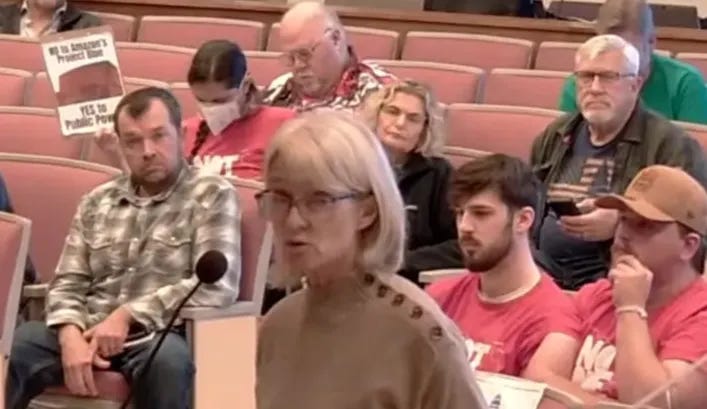
Another wrinkle popped up Tuesday, when an attorney representing the No Desert Data Center Coalition told the board she believes the county violated the state’s open meeting law during early discussions about Project Blue.
Some readers might remember that when we first wrote about Project Blue, we used some janky blurred photos — clearly a satellite image — pulled from county documents.
Part of the coalition’s argument is that the intentional misdirection used to obscure what Project Blue really was — tied to the county’s nondisclosure agreements with the developers — meant that some officials didn’t fully understand what they were voting on.
So whether it’s Project Blue missing a legal deadline or the No Desert Data Center Coalition alleging an open meeting law violation, the county should probably expect a lawsuit gift-wrapped for early next year.

Let the naming contest begin: A never-before-seen jaguar was spotted in southeastern Arizona last month, the Arizona Daily Star’s Henry Brean reports. A motion-activated camera run by researchers at the University of Arizona snapped pics of the jaguar nine times on three different days. It is the fifth jaguar spotted in the U.S. since 2011.
A very Tucson celebration: Pueblo High School’s Mariachi Aztlán serenaded the new members of the Tucson City Council as they were sworn in on Tuesday. The new council is one of the most diverse in memory, with five women on the council for the first time and more queer and Latina officials, the Arizona Luminaria’s Carolina Cuellar reports.
Enough shade for everybody: Tucson Mayor Regina Romero took a few minutes of Tuesday’s City Council meeting to address the city. She pointed to challenges like “an economy that too often works only for those at the top, a state Legislature that ignores our public schools and increasingly takes the burden away from big corporations,” the Star’s Charles Borla reports. And she threw some shade on the federal government for “making life more unaffordable” by cutting health care, SNAP and housing resources.
Somebody took an infographic tutorial: The good people on the University of Arizona’s MAP team have upped their game. If you’re a fan of data, you can see the hyper-local data and comparisons to peer cities that MAP has gathered for years, but now with animated graphics. Their newest release shows how the Tucson metro area’s economy fared over the past decade. It’s pretty cool.

Why do we like this kind of data?: Because it can help predict things like school closures. Right now, Amphi district officials are planning to close four elementary schools due to low enrollment, and they’re pointing to Pima County’s declining birth rate, along with school vouchers, as two of the main reasons fewer students are enrolling, Arizona Public Media’s Noor Haghighi reports.
One of the key data points we track is how many readers upgrade to paid subscriptions.
Wait, electric bills can go down?: UniSource is lowering electric bills this month for customers in Santa Cruz County, KVOA’s Robby Reynold reports. The utility added a surcharge in 2023 to pay for higher fuel costs, but those costs have now been recovered and customers will see an average $19 drop in their monthly bills.

House Speaker Mike Johnson says he’s going to swear in Representative-elect Matt Van Epps on Thursday, two days after Van Epps won a special election in Tennessee’s 7th Congressional District.
For those keeping track, that would be 48 days faster than U.S. Rep. Adelita Grijalva was sworn in after she won a special election in a landslide.

We’re certain it has nothing to do with the fact that Van Epps is a Republican and Grijalva is a Democrat. Or that at the time, Grijalva was going to be the tipping point vote to release the Epstein files.
Just a coincidence, right?
Or maybe Van Epps already bought tickets to D.C.
While I understand that lots of people use ChatGPT and other AI tools these days, I’m firmly in the camp of boycotting active engagement with AI. We are unwittingly engaging with some of these technologies just by existing in modern society, but actively “feeding the beast” by engaging with the tools is a bridge too far. I respect you all and know you’re not using it for unethical or frivolous reasons, yet I hope you might reconsider featuring these AI sources as information gathering tools while reporting on the true harms of the systems that power them.
Interesting article, and certainly reorders in my head how I thought this was all organized. You said Blue Owl is an “alternative investment” firm? What does that mean? And who would own the end product if not Meta/Amazon?
My usual CYA statement here: I have no opinion on Project Blue, but I’m interested in how this works.