

Tucson said no
Will the Corporation Commission listen? ... New tenants for Project Blue? ... And that's one twisted tongue bath.
Tucson is sending a crystal-clear message to the Arizona Corporation Commission ahead of today’s meeting in Phoenix: Don’t sign off on an agreement between Tucson Electric Power and the developers behind Project Blue.
Nearly 500 Tucson residents wrote to the ACC urging commissioners to reject TEP’s request to supply energy to Project Blue, the massive data center that Beale Infrastructure is trying to build on Tucson’s southside.
Under the proposal, TEP would sell roughly 300 megawatts daily to run the initial phase of the planned data centers. To put that in context, that’s the equivalent of hundreds of thousands of homes’ daily use in Tucson.
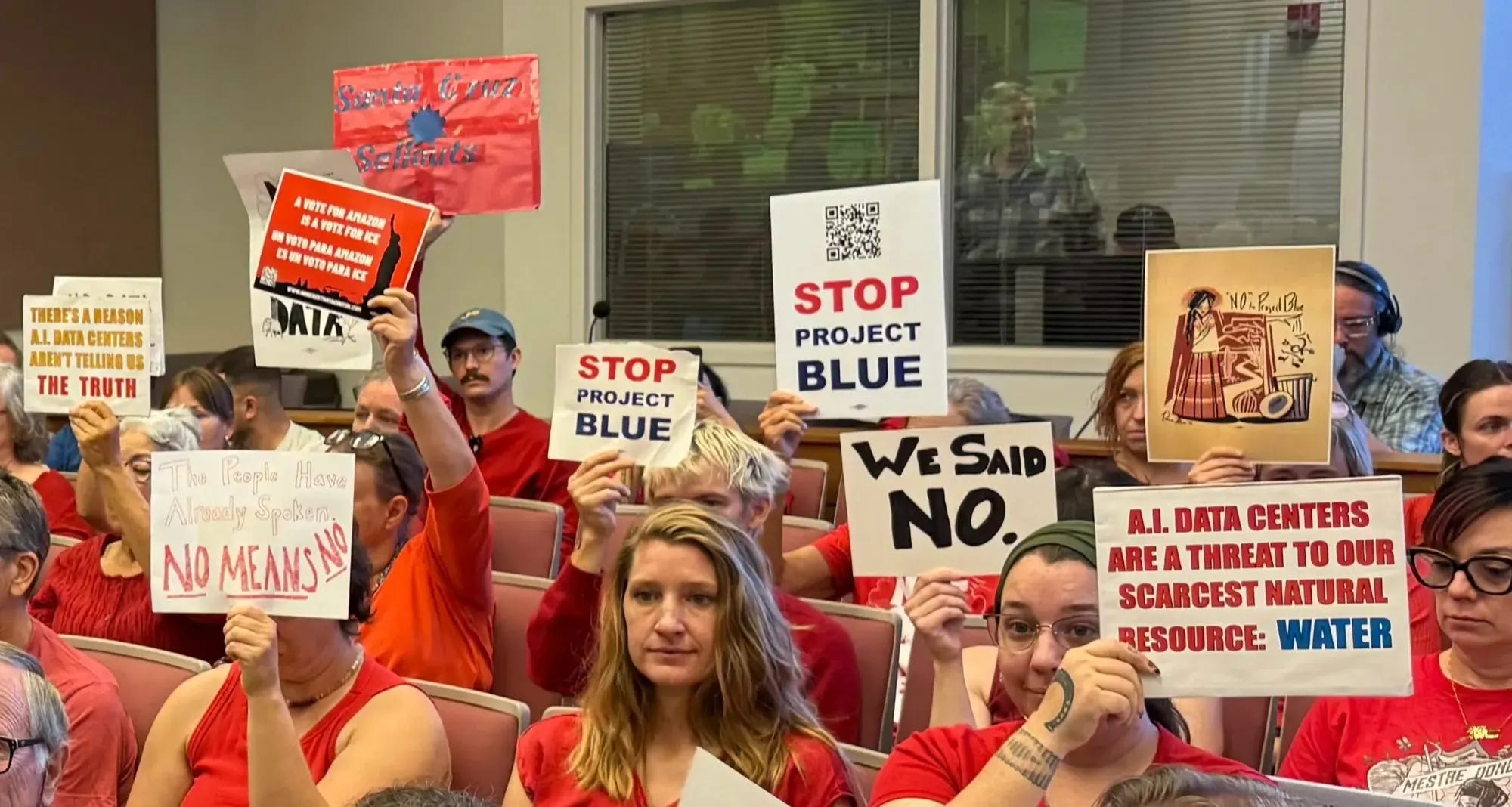
Totaling nearly 1,000 pages on the docket, residents of Southern Arizona are unanimous in their demands that the ACC reject the proposal.
Their main concerns are about long-term energy prices for consumers, potential brownouts, water use, and air pollution.
“A data center will put a massive and unnecessary strain on our electrical grid that will be felt by the community,” Tucson resident Lattney Jones wrote. “Allowing a data center to draw off our electricity sends the message to residents and local businesses that their needs are secondary to those of a data center which, in essence, won’t even be serving the Tucson community.”
And more letters are still trickling in.
The commissioners also had their share of questions about how the proposed plan would work. They asked TEP to clarify how it plans to deliver 100% renewable energy for the project by 2028. Spoiler alert: TEP plans on buying energy credits, which means buying green energy being produced outside of Pima County.
There was just one letter submitted in support of the energy agreement on file, but it came from the Arizona Commerce Authority, not Tucson residents.
The real question is whether the five Republicans on the commission — four of whom live in the Valley — will listen to Tucson residents and the elected Democrats in Southern Arizona opposed to Project Blue.
Tucson Mayor Regina Romero is one of the highest-profile critics of the project. When the Council unanimously voted to kill the annexation process for Project Blue this summer, she said she was skeptical that state and federal agencies would act in the best interests of Tucson residents when it comes to data centers.
The ACC’s decisions are directly responsible for energy costs that are too high for working families, Romero said.
“The Commission needs to be responsive to Arizonans’ economic needs and take rising energy prices seriously. Clean energy is affordable energy, and our state is best served when we invest in renewables rather than tripling down on costly fossil fuels,” Romero told us Tuesday.
We talked to the sole commissioner from Tucson, Lea Márquez Peterson, a few weeks back on the Bill Buckmaster Show.
While Márquez Peterson didn’t take a position on the request at the time, records show she has been busy in the last few weeks peppering TEP with technical questions about where the energy will come from and what it means for residential ratepayers.
The Tucson Republican pushed TEP for details about the air-cooled technology. She also questioned whether the utility has done enough due diligence on the developer’s ability to pay for the additional 300 megawatts in the long term.
The City of Tucson has asked to weigh in on the request — which isn’t unusual — but it does signal the Tucson City Council still has concerns about the energy demands for the planned data centers.
By comparison, Pima County, Arizona Attorney General Kris Mayes, and the city have filed similar paperwork on a separate case, TEP’s 14% rate increase.
Non-governmental groups are also ready to speak. Groups including the No Desert Data Center Coalition, Tucson chapter of the Democratic Socialists of America, Chispa Arizona, AZ AANHPI For Equity, Mi Familia en Acción, Sierra Club Grand Canyon Chapter, Climate Power, Green Latinos and Poder Latinx are all expected to deliver testimony today about their opposition to the energy agreement.
While the ACC gets a bad rap for being a rubber stamp for the business community, it does say no sometimes.
The meeting starts at 8:30 a.m., and you can watch it here.

Adios, Bezos — Hola, Zuck: Amazon dropped out of operating Project Blue, saying it can’t use air-cooled data centers, which the developer switched to instead of a water-cooled facility in order to sidestep the fact that the Tucson City Council wouldn’t annex the land and provide water to the property. Instead, the developer is negotiating with Meta, Facebook’s parent company, to operate the facility, per the Daily Star’s Tony Davis, who used anonymous sources to break the news.
Recall alert: We’re still waiting on the official final count of valid signatures from Benson voters to spark a recall against a host of politicians in the Southern Arizona city next spring, but it looks like there will be a few recalls. The Herald-Review’s Terri Jo Neff reports that council members Patrick Boyle, Darren Hayes, and Nick Maldonado will likely face recalls after county officials concluded their first signature review. It’s less clear if council member Levi Johnson will face a recall. Meanwhile, Mayor Joe Konrad escaped a recall after folks upset over the aluminum smelter facility in town failed to gather enough signatures to force a recall against him.
Elsewhere in Southern Arizona: Bisbee is the best downtown in all of Arizona, per the Republic’s Paige Moore, who highlights the town’s art, ghost tours, antiquing, hotels and restaurants. Meanwhile, Tombstone’s Bird Cage Theater was Arizona’s hottest spot for theater, music, comedy, speechifying and magic shows back when it was built in 1881, as Sam Dingman discusses with Bird Cage Theater historian Michael Paul Mihaljevich on KJZZ’s “The Show.” The theater is still standing and open for tours.
“I think it’s so easy to look at these two things that we’re talking about, social media and 19th century variety theater, and see that they’re obviously different, but they draw from the same pattern of people wanting to satisfy their financial wants by recognizing an opportunity, by putting themself out there and gaining viewership,” Mihaljevich explained.

Copper, cattle and canyons: New copper extraction methods involving sulfuric acid and bacteria have brought the previously closed Johnson Camp southeast of Tucson back to life, helping to satisfy the nation’s “insatiable demand” for Arizona’s copper, per the Wall Street Journal. Meanwhile, the New World screwworm is wreaking havoc on Mexico’s beef industry — the half-dozen border cattle-crossing points have been closed for a year, and beef importers in Arizona, like Juan Manuel Fleischer, are “basically going broke,” he told the Washington Post. Finally, Interior Secretary Doug Burgum announced that, starting January 1, it’ll cost foreigners $100 per person to visit the Grand Canyon and many other national parks, a move that has tourism-oriented businesses worried, per the Associated Press.
We help satisfy your insatiable demand for local news.
It ain’t copper, but that’s worth a few bucks, right?

We knew Kyrsten Sinema tried ibogaine in Mexico.
The question is: Will ibogaine treat brain worms?
Considering how cozy Sinema is getting with Robert F. Kennedy Jr, we might get an answer soon enough.
Sinema has spent her post-senator days lobbying for data centers and psychedelics. Now she’s kissing up to the U.S. Secretary of Health and his Make America Healthy Again campaign, the Phoenix New Times’ Zach Buchanan writes.
That involves “tongue-bathing” RFK Jr, who Sinema refers to as a “disruptor,” rather than a weird old dude who thinks vaccines don’t work, leaves dead bears in parks and wears jeans when he climbs Camelback Mountain in the summer.
I gave Sinema a lot of monies for her 2018 campaign! I will never forgive her for voting against a minimum wage increase with her little curtsy thumbs down vote! Cozying up to the clown RFK Junior is disgusting!!! Thank goodness for Senator Gallego!!!
Project Blue, via Beale, claims dry cooling will save water. it will not. With dry cooling, it is truly not dry cooling. It is only dry cooling onsite, with a lot more water use than ever, offsite. It would be transferring cooling and water use to power plants that will use water for at Tucson Electric Power electric power plants. Huge profits would be made by TEP if Project Blue were to be built. Beale is essentially the broker (or perhaps flipper) for Project Blue. They said 1910 acre-feet would be used for cooling. They left off the roughly 7400 acre-feet that TEP would use for offsite cooling of power plants. That totals about 9300 acre feet for the wet cooling method. But now they have switched to so-called "dry cooling."
My analysis shows this.
With the current plan to use "dry cooling" at the Project Blue site, the water use would even go even higher. Project Blue would use about 14,800 acre-feet per year, an additional 5,500 additional acre-feet over the wet cooling method. This is because onsite mechanical cooling in our arid climate is much more efficient than HVAC/heat transfer technology. Evaporative cooIing has an efficiency of 10-40 units (called coefficient of performance or COP). HVAC only has a rating of 3 to 6. If you want to see my fully documented spreadsheet on this, you can contact me.