
Tucson’s long-running experiment with fare-free transit is quietly approaching a political crossroads.
The Tucson City Council will spend at least 45 minutes today during their study session digging into mass transit funding — and, whether they say it outright or not, the future of free bus fares.
While the council has not adopted the city manager’s revised budget recommendation for next year, the “menu” of options stops short of recommending a return to the pre-2018 fare model, which once generated about $13 million annually for city coffers.
There is a line-item about $8.5 million in “net revenue from transit fares” in City Manager Tim Thomure’s budget menu, but that figure is expected to be offset — not generated — by revenue from Visit Tucson, the Regional Transportation Authority and an increased surcharge tied to electric bills.

With an estimated $1.1 million price tag just to restart fare collection, we’re guessing it won’t be part of the FY27 City of Tucson budget — at least not without a political fight. Those costs include reopening and staffing an office to offer reduced fare passes for low-income riders and new self-service kiosks to buy passes.
That could change quickly. Today’s discussion could pivot if any council member decides to force the issue with a vote. Both Council members Paul Cunningham and Nikki Lee have been vocal about avoiding deep, permanent budget cuts without at least reconsidering fares for some riders.
We’ve noted in the past that Mayor Regina Romero, as well as Council members Lane Santa Cruz and Kevin Dahl, have voted to keep transit fare-free over the last few years and Council member Miranda Schubert is a big proponent of fare-free buses.
A study commissioned by the city and conducted by researchers at the University of Arizona lays out the stakes: roughly one-third of current riders could disappear if fares return, the pair from the UA wrote.
The professors from the UA’s College of Agriculture, Life and Environmental Sciences point to research showing that households without a vehicle increased by 97% between 2019 and 2025 — a shift that makes transit access even more critical, particularly for low-income residents.
A drop in ridership wouldn’t just hit bus routes. The report argues it would ripple outward — dragging down property values and shrinking sales tax revenues along transit corridors.
The city has long offered free or reduced fares for low-income riders, but transit advocates say the process has historically been cumbersome and inaccessible, requiring documentation and in-person visits during limited hours.
Notably, the 96-page report sticks almost entirely to economics and sidesteps public safety concerns raised by critics.
Groups like the Tucson Crime Free Coalition have long argued fare-free buses have contributed to increases in violent crime, property crimes at local businesses and a drop in “choice riders” — those who could drive but opt to use mass transit.

A post from Tucson Crime Free Coalition about an incident in February.
Others have argued it has exacerbated the region’s fentanyl crisis, but it is harder to draw a straight line from free fares to increased drug use.
There is a lot of anecdotal evidence to support the claims made by the Tucson Crime Free Coalition, but less hard evidence from neutral third parties that ties crime to free fares.
The council has already begun investing in a parallel strategy to address crime tied to public transit: by making the system feel safer. Recent funding boosts have gone toward increased security presence and a new “ambassador” program designed to help riders navigate the system.
RTA Next also will have dedicated funding for mass transit safety over the next 20 years. It isn’t clear exactly how that money will be spent, but many expect the city-run Sun Tran to receive the lion’s share of the funding.

The Pima County Supervisors’ fight with Pima County Sheriff Chris Nanos will still be the top issue at today’s meeting.
Here are four items we’ll also be watching:
Only the feds care: Supervisor Matt Heinz wants to add a state corruption law to the county’s lobbying strategy, likely aimed at next year’s legislative session. Arizona doesn’t have one, meaning if Attorney General Kris Mayes wanted to prosecute a certain county official, she currently couldn’t under state law. Right now, only the U.S. Attorney for the District of Arizona would have jurisdiction to bring those kinds of charges.
Going to the ballot: The supervisors are expected to refer an expenditure limit increase to the November ballot today. The county cannot spend more than limits set in 1980, regardless of population growth or inflation. The proposal wouldn’t raise taxes — it would simply allow the County to spend money it already collects, similar to raising a credit limit. The county received three nearly identical letters opposing the increase, urging supervisors to delay any action until 2028 — when several of them are up for re-election.

AZPOST for sheriffs/constables: Heinz also wants elected sheriffs and constables to be AZ POST-certified after they take office — closing what he sees as a loophole. Currently, elected officials are not required to complete the same training as other peace officers mandated by the Arizona Peace Officer Standards and Training Board.
Bullet trains to Phoenix: The supervisors will also be asked to approve a lobbying campaign for high-speed rail service — up to 125 mph — between Mexico and Phoenix, with a stop in Tucson. The request comes as Mexican President Claudia Sheinbaum looks to heavily invest in both commercial and passenger rail service that would terminate in Nogales, Mexico.

No takers: Although Pima County Sheriff Chris Nanos has been taking heat ever since Nancy Guthrie disappeared and the Republic reported he lied on his résumé, the Green Valley Council’s Board of Representatives didn’t take him up on his offer to answer questions about the hot-button topics, Kim Smith reports for the Green Valley News. Instead, they thanked Nanos for always keeping the Green Valley substation well-staffed, asked him about the Board of Supervisors turning down federal Operation Stonegarden grants, and listened to Nanos explain his department’s budget difficulties.
Midway through his presentation, Nanos stopped and told the crowd, “I want to give you an opportunity to question me because there’s a lot going on out there about this bad sheriff you have.”
Get your space telescope at the UA: The former CEO of Google, Eric Schmidt, is going to be this year’s commencement speaker at the University of Arizona, per UANews. Schmidt founded a tech company that is developing the world’s first privately funded space telescope, which dovetails with the UA’s focus on optical engineering.
And get your space merch in Sierra Vista: Some type of new military mission is going to start at Fort Huachuca, but locals aren’t quite sure what to make of it, the Herald/Review’s Matt Hickman writes about a recent Cochise County Sunday Roundtable. The general consensus is that it will be a U.S. Space Force mission, and “as long as it’s not two guys sitting in a gift shop selling Space Force T-shirts, we’re going to call it a win,” Hickman writes.
We’d call it a win if you decided today was the day to upgrade to a paid subscription.
Return to sender: Arizona Democratic Sens. Mark Kelly and Ruben Gallego say they haven’t heard back from Department of Homeland Security officials about the expansion of ICE detention centers in Arizona, including the former state prison in Marana, Alisa Reznick reports for KJZZ. Kelly and Gallego sent a letter to DHS in February asking for information about the detention centers and now they’re calling for a halt to any new centers until they get a response.
Taking the first step: While Arizona’s senators write letters and demand answers, Tucson activists created an interactive map to show where ICE agents have been spotted in town, the Tucson Sentinel’s Mia Kortright reports. Organizers of the “Migra Map,” which uses reports from volunteers over the past 18 months, are trying to categorize the sightings based on how much evidence is presented, like whether the report was confirmed or included a raid.
"Our real intent is to stop the kidnappings," Derechos Humanos co-chair Isabel Garcia said in a phone interview. "But we have to start by witnessing and documenting.”

Debates season is right around the corner!
As we prepare to grill the candidates as part of the Arizona Citizens Clean Elections Commission legislative debate series, we want to know what issues matter most to you.
Sure, we know you care about issues like education, elections, water, the border, infrastructure and the environment.
But those are pretty broad.
So this week, we’re asking you to help us narrow it down a bit by filling out some simple surveys. Today’s “What’s Your Issue” is about social services.
Think of it this way: If we can only ask candidates about one of the subtopics on this list, what should it be?
When it comes to the environment

In the world of political mudslinging, the upcoming brawl in Congressional District 6 promises to be one of the dirtiest in the nation.
We stumbled across JuanLies.com, which was registered anonymously last year, targeting two-term Congressman Juan Ciscomani.
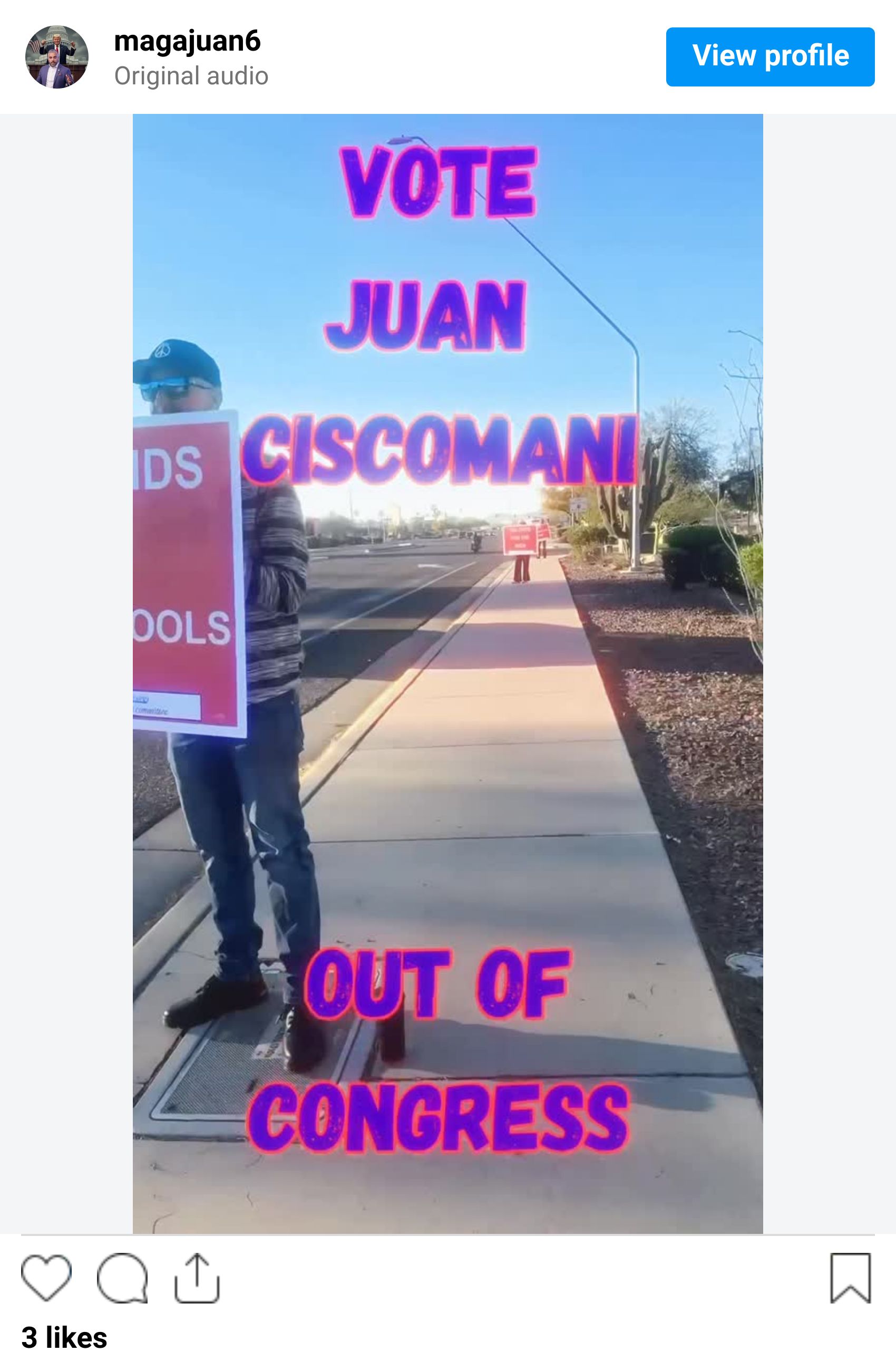
The website highlights a ”MAGA Shave” campaign, which has been holding protests outside of his midtown Tucson office for several months.
We will let you know what clever website criticizing his competition pops up next, but so far we got nothing.