

Secret Santa: Subtlety on a deadline
Daily coverage, with an elegant touch.

We’re wrapping up the year before we take our winter break from publishing.
That break runs from next Monday to the first week of January. As longtime Agenda readers know, these breaks are a time for us to get caught up on all the little things that fall through the cracks, sort through the business side of the Agenda and plan our coverage for next year.
We also take stock of our work over the past year. This time around, we wanted to get a little creative, so we combed through each other’s stories and talked about the ones we especially liked.
It’s kind of like a professional Secret Santa, and we thought it would be fun to share those stories with you.
To kick it off, Curt is writing about his favorite story that Joe wrote. (There is a long list of honorable mentions, too.)

Joe did a bang-up job covering Project Blue this year, but that’s not why I like this story so much.
What I like is the elegance of the format.
If you’ve never covered a public meeting as a reporter, you might not grasp how difficult it is to make those meetings interesting to the reader.
Amid hours of often-boring discussion, reporters have to home in on key moments and discard the extraneous details. Then they have to find a way to present it to the reader that’s lively and easy to digest, while delivering the information readers need to understand what’s happening.
The meeting Joe wrote about in July was more dramatic than most, but it still required a lot of skill to turn into an interesting piece of writing.
Here’s what Joe did: He picked the most insightful questions asked by the public and summarized the answers that officials gave. Then he added “our take” to help the reader understand the context better.
“We could have written this up as a straight news story, but we’re taking a different approach today — drilling down on three public questions that stood out during the meeting,” Joe wrote.
This is classic local journalism, with a newsletter touch. It’s not flashy. It’s subtle.
Joe’s choice of format elevated the voices of regular people and put them on the same level as the officials and executives in the room. Tucsonans showed up prepared with thoughtful questions and Joe’s story reflected that.
Joe also didn’t let officials get away with squishy answers to those questions, like when an official leaned on a plan that had no real teeth to it.
I also appreciated the drops of humor in the story, from calling it “Project Bezos” to pointing out that the developer made sure not to utter the word “Amazon.”
In the end, Joe put together a breezy, informative story that easily could have been a chore to read. And he did it on a tight deadline.
With that, I’ll let you get to actually reading the story.
This is just one of hundreds of great stories we write every year, all of which are made possible by our paid subscribers.
Asked and answered
Project Blue’s first meeting.
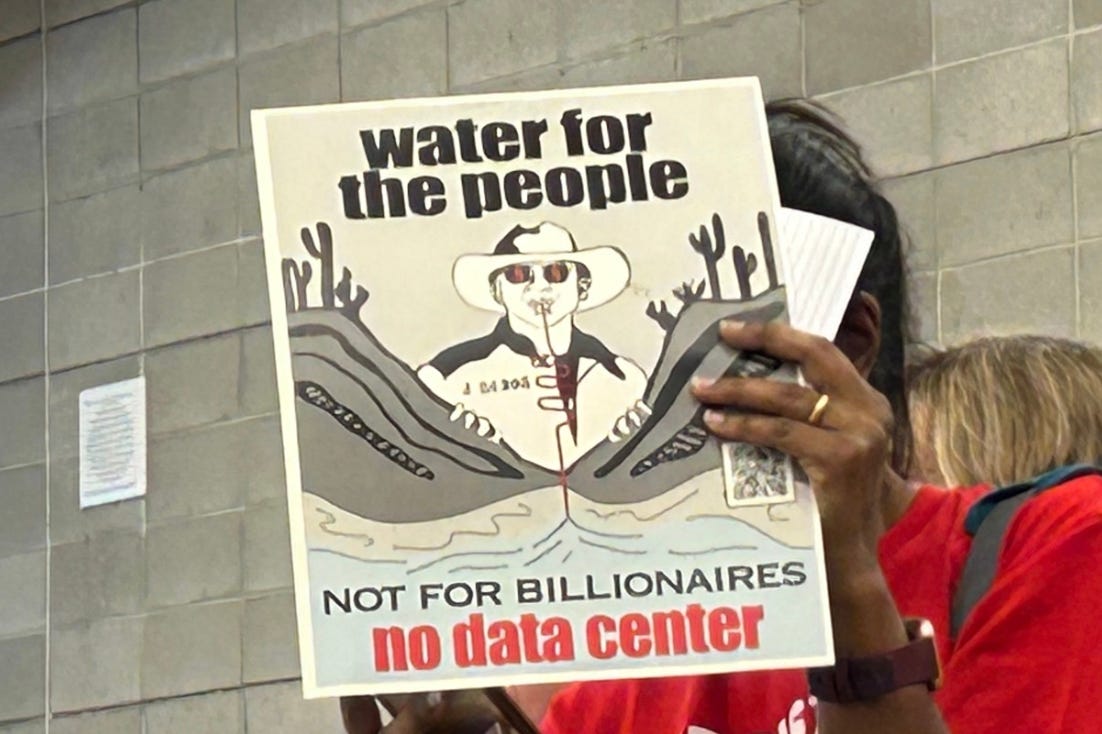
Project Blue — or “Project Bezos,” as some have started calling it — drew a fiery crowd at Wednesday night’s public meeting, which quickly devolved into prolonged shouting matches, broken up by occasional discussion about the massive economic development project planned for Tucson’s southeast side.
About 800 people packed into Mica Mountain High School near the proposed data center campus. The crowd included city and county officials, union members pushing for a commitment to use local labor during construction, and a whole lot of Tucsonans worried about water use and pollution.
We could have written this up as a straight news story, but we’re taking a different approach today — drilling down on three public questions that stood out during the meeting.
Some questions felt like softballs for the developer — maybe they were, maybe they weren’t — but we’re skipping those and focusing on what seemed like genuine exchanges between the public and either the developer or city staff.
A quick editorial note: Wednesday night’s discussion focused specifically on the initial phase of the project — a 290-acre parcel near the Pima County Fairgrounds.
Other phases — including a completely separate plan to build an even larger data center cluster somewhere else in the Tucson area — weren’t discussed during the two-hour meeting.
Question #1: Can we cut off the water?
“So if there’s some big change — a new Colorado River agreement or if extreme drought continues (for multiple years) — does Tucson Water have the sole discretion to restrict (Project Blue’s consumption)? And how would you balance data center versus residential?”
The city’s answer: Tucson Water’s deputy director, Scott Schladweiler, said the city doesn’t expect a water emergency that would trigger rationing. He pointed to the city’s One Water Plan, a long-term water strategy that includes ways to regulate large-scale industrial use of reclaimed water.
The plan, which was developed with community input, includes contingencies for reduced Colorado River allocations and calls for increasing the use of reclaimed water to reduce dependence on potable supplies.
It also outlines “Pure Water Tucson” — a long-term initiative to upgrade facilities and infrastructure so reclaimed water can eventually be turned into drinking water. The plan looks 75 years into the future.
Our take: The 2023 One Water Plan is a solid roadmap — but it’s still a guiding document, not a binding contract.
Things get more complicated with the upcoming City Council primary, which will bring at least two new members who never voted on the water plan. And with changes in budgets, water-saving tech, federal laws, and interstate compacts, Tucson’s One Water plan’s long-term goals are more aspirational than guaranteed.
The more interesting twist: Councilwoman Nikki Lee has this exact question on her list, which means the city will likely address it formally before voting on the Project Blue development agreement.
Our guess is that the final agreement will include some sort of clause capping the amount of reclaimed water the data centers can use.
Question #2: When will it really switch to reclaimed water?
“The draft agreement states that you promised to use potable, drinkable water for only two years prior to switching to reclaimed (water). (What if) oops, you know, we need to keep using potable a little while longer? The only recourse is making you pay more money. The draft agreement states water allocation caps, reclaimed water. But breaking those caps won’t result in the city cutting off Project Blue’s water. Instead, there will just be extra charges. Charging more does not give water back. Money is not water. Money and water are not fungible items.”
The city’s answer: City Manager Tim Thomure responded that the current draft — released to Council and the public on the same day — doesn’t yet include a mechanism to shut off the water if the developers miss that two-year goal of moving from potable to reclaimed water after the 18-mile pipeline has been built. The developers have publicly committed to starting construction of the pipeline at the same time as the development.
Thomure defended the current proposal, noting that Council hasn’t had a chance to discuss the draft yet — they didn’t meet in July — but he expects them to take it up at the August 6 City Council meeting.
Our take: No version of the draft agreement will satisfy everyone. Most members of the Council, if not all, have a running list of unresolved questions.
As we mentioned earlier, water use terms will likely become a non-negotiable part of the final agreement. If annexation moves forward next month, it could still be months before the final — and public — vote.
Question #3: Will ICE use Project Blue?
“Now that we know the company that’s behind this project that the developer is acting on behalf of, which is Amazon Web Services, I also want to draw attention to the fact that in addition to being an anti-union mega corporation, Amazon Web Services works with a number of tech companies, including Palantir, which is contracting with the federal government specifically with DHS and ICE to surveil and police immigrants. … How do we know that this data center isn’t being used to support companies that are actively targeting members of our community?”
Beale Infrastructure’s answer: Arnaud Dusser, their director of development, was careful not to use the word “Amazon” but said this would be a typical data center that is being used by the public — citing a huge, growing demand for traditional cloud infrastructure.
“It’s something that we use every single day, every single person in this room uses in their personal lives. Our modern economy runs on it. It’s absolutely integral to our modern economy in our daily lives. It’s what’s driving. It’s really the backbone of the Internet,” he said.
Our take: It’s going to be impossible to know who will use these services once the data centers are built. If getting the actual end user was veiled in secrecy, we’re guessing they will take even more steps to keep their list of clients a well-preserved secret. Unless there is a data breach, we’ll probably never know whose data is being stored in Project Blue.
One last note on Project Blue, Tucson Mayor Regina Romero issued a statement on her position on data centers. She says she’s still neutral.
“There has been some speculation as to my position on Project Blue. To be clear, as Mayor, I owe it to the residents of Tucson, now and into the future, to make decisions that will protect our water resources and our environment. I continue to consider policy priorities that I think will move Tucson forward. My only position, right now, is to complete my due diligence to research, ask questions, analyze information, listen to residents, and to consider the actual draft development agreement before us.”
To date, only one member of the Council is on the record dead-set against it — Councilman Kevin Dahl.
There's actually another Council Member on record opposing Project Blue. https://tucson.com/opinion/column/article_7b4e7676-05de-4c28-a11a-bb83f99023ae.html