
Democratic Senate President-elect Priya Sundareshan of Tucson has spent much of the last four years trying to get the Arizona Legislature to take the state’s water problems seriously.
But legislative Democrats like her have long played second fiddle to a Republican majority, even as statewide elections have swung blue. So, each year, the numerous bills Sundareshan introduced to limit overuse — particularly of groundwater — and close regulatory loopholes almost uniformly failed, even with the backing of Democratic Gov. Katie Hobbs and buy-in from some local Republican officials.

Priya Sundareshan speaks at an event in 2025. (Gage Skidmore)
Some years, the Legislature came close to a compromise. But Republican lawmakers wouldn’t pass a bill that regulated water consumption too tightly for their taste. Hobbs wouldn’t sign a bill that didn’t do enough.
And there’s the infamous (if you’re as nerdy as we are) Gail Griffin, a Republican lawmaker who has long ruled the House Natural Resources, Energy and Water Committee with an iron fist, refusing to hear groundwater reform bills from Republicans and Democrats alike.
Throughout those years of non-progress, the health of the state’s water system has continued to diminish.
The entire Colorado River basin faces chronic overconsumption and climate change-aggravated drought that seems to get worse every year. The seven states of the basin failed to replace expiring agreements with a new river governance framework, and Arizona now faces severe Colorado River cuts.
Even if that were all to go away, the state’s underground aquifers would still be at critical levels, a point made all too clear by the literal sinking of some communities in rural Arizona.

A graph of declining groundwater levels in Arizona’s three main Active Management Areas. The loss of Colorado River water could drive increased groundwater pumping. (Bridget Scanlon/University of Tennessee at Jackson Bureau of Economic Geology)
But another hydrologic phenomenon — indulge us for a moment here — may shake up the status quo at the Capitol: a blue wave (or red undertow).
The election ended decades of Republican control of the Legislature, ushering in handy Democratic majorities in both the House and Senate to accompany the reelected Hobbs. Democrats will now decide what bills get heard in the Legislature’s natural resource committees.
And days after the election — one that prominently featured water in the political discourse — Sundareshan, who has held several leadership positions within the caucus, was picked as Senate president.
That means the water nerds are in control.
But what do they want to do with this newfound hydro-political power? And what kinds of water policies does Sundareshan in particular want to put on the table?
This week, we sat down with the Senate president-elect to find out.
Short version: Rural groundwater rules are back, and a data center moratorium isn’t off the table.
Here’s our conversation, edited for clarity and length.
Tucson Agenda: We saw water surface as a major issue for voters and candidates up and down the ballot this year. How do you read the results of the election in terms of what voters feel about the water situation? And how translatable are those feelings into legislation next session?
Priya Sundareshan: A lot of what we were hearing at the doors when our candidates were talking to voters — and we were conducting polling as well — was that water was coming up as a top-three to top-five issue in every district that we were polling in. Colorado River issues are in the news a bunch. Voters are aware, and they know that something related to water needs to be done.
I think it’s been pretty clear at the legislative level that I’ve had ideas on water, and none of them are getting hearings by the Republicans. Potentially some of that was coming through, that Democratic ideas on how to strengthen groundwater protections are just getting nowhere with the Republican majority that we had. With water being one of those top issues that voters are facing, that’s absolutely something that we want to be able to deliver on with our new trifecta.
TA: On that note, what kind of water bills are you thinking about for this session?
PS: I probably will reintroduce all of the bills I have been introducing, which come from my desire to see rural groundwater protections, because there’s a large part of the state that has nothing really protecting groundwater at all, and the first to sink their well gets it all — and sorry to anybody who lives there, right? So we absolutely want to make sure we’re closing that huge gap on rural groundwater. Let’s set some management areas, something geared to be rural-specific, very locally driven.
In a lot of these rural areas, groundwater depletion is occurring at extremely fast rates. I think the goal (of previous legislation, such as 2025’s proposed Rural Groundwater Management Act) was in the first 10 years a 20% reduction in the overdraft, so that we could start getting these areas back on a sustainable trajectory, and then in the next 10 years, another 10% and beyond. So we’ll see something in the rural space.

There are some very similar bills to also close some loopholes in our urban (Active Management Areas), right? Our existing AMAs are pretty decently managed, but have some gaps there that are now starting to become big issues, like build-to-rent communities — all that’s required in an AMA is that you have to prove an assured water supply for 100 years, but only if you’re building a subdivision of six or more houses for sale per year.
But you have situations like a build-to-rent community where it’s not for-sale housing, so they don’t have to actually prove an assured water supply in order to build. That’s exactly what led to the Rio Verde Foothills situation with these wildcat subdivisions where there’s development that is occurring on a piecemeal basis intentionally to subvert that six-or-more requirement. We should not be in a situation where you thought that the law was protecting you, and now it’s not.
Now, obviously, the legislative picture has changed, and we are in a governing mode, and so there’s going to be the need to discuss and work through any issues, to make sure that we get that stakeholder input and are able to see what’s actually possible.

The face of Gail Griffin, a stone-cold bill killer.
TA: This is kind of a two-parter. How much of the lack of action on water over the recent years can be explained by partisanship and the specific characters that were in those seats versus structural influences? I’m sure the home builders, for example, were smart enough to donate to some Democrats, too. People hear desires from local constituents for growth, or things like that. Which is maybe another way of asking: What other obstacles do you think might exist, now that the partisan question has been solved, to these kinds of bills?
PS: In the past, I felt like there was some very sincere bipartisan activity in those negotiations that ended up meeting a roadblock on the House side (in the form of Griffin). So that’s even less of a partisan issue than it is a personal issue. We’ll have to see whether those industries that were very powerful with Rep. Griffin also have the ability to make it difficult, even now with the Democratic trifecta.
But I do think that given how widespread the awareness is with voters that water is an issue and we’ve got to be doing more, that they understand that water is scarce. They understand that protections have been held up, and so I think that we’re going to see something happen.
TA: Have you had any conversations with the governor’s office or Arizona Department of Water Resources chief Tom Buschatzke about priorities for this session?
PS: Not yet. I literally just got elected Senate president. We’ve been focused on a few other things. We’re building our committees now. We’re going to have those conversations very soon.

ADWR head Tom Buschatzke testifies before Congress.
TA: Is there anything that you can see the Legislature doing, or that you would want to do on surface water policies, specifically the Colorado River?
PS: In my first year in the Senate, WIFA (the Water Infrastructure Finance Authority of Arizona) had a $200 million conservation grant that was intended to permanently retire certain uses or find efficiencies in water that would give us these lasting benefits. That is a very useful and important tool. And if we are able to luck into some money, that’d be great. If we can plus that up with whatever additional money we have, that’s still important.
I have always felt that our lowest-hanging fruit is the conservation space. We’ve got to figure out how to do more with less. We know there are ways to achieve efficiencies. We know the tools, we know the techniques, and we just really need to focus and implement and do a lot more there.
I’m not going to say that augmentation (WIFA’s main focus) doesn’t have its place, but certainly the Doug Ducey proposal, which was a billion dollars to augmentation with only $200 million towards immediate conservation, felt like the wrong ratio to me. If we can find additional money, I would definitely want to put some more into the conservation program because I think that’s where you can find your immediate results from water reductions and efficiencies.
TA: What are we going to do about data centers? There’s clearly lots of talk of a moratorium. But I can imagine, maybe, some of this newer class of Democrats, especially those who flipped a seat in a rural or exurban area, feeling a little differently than those in the middle of Tucson.
PS: Well, I think that’s where we do need to come together as a caucus and find out what have my new members actually been experiencing on the campaign trail.
My guess is that those new members are not hearing that much different than what my existing members have been hearing. When I’ve been out on the campaign trail with them — like in that Chandler district, that LD13 that we flipped, right — it’s Chandler, which recently had its city council vote against a data center. So I don’t think that new members are feeling any different about the need for some action on data centers. My Pinal County new member has been talking to voters who have significant concerns about data centers and the rising utility rates that could be a result of data centers. I think those issues are actually pretty widespread. They’re pretty bipartisan, and I’m fairly certain that all across the state, those issues have been pretty front and center for a lot of voters.
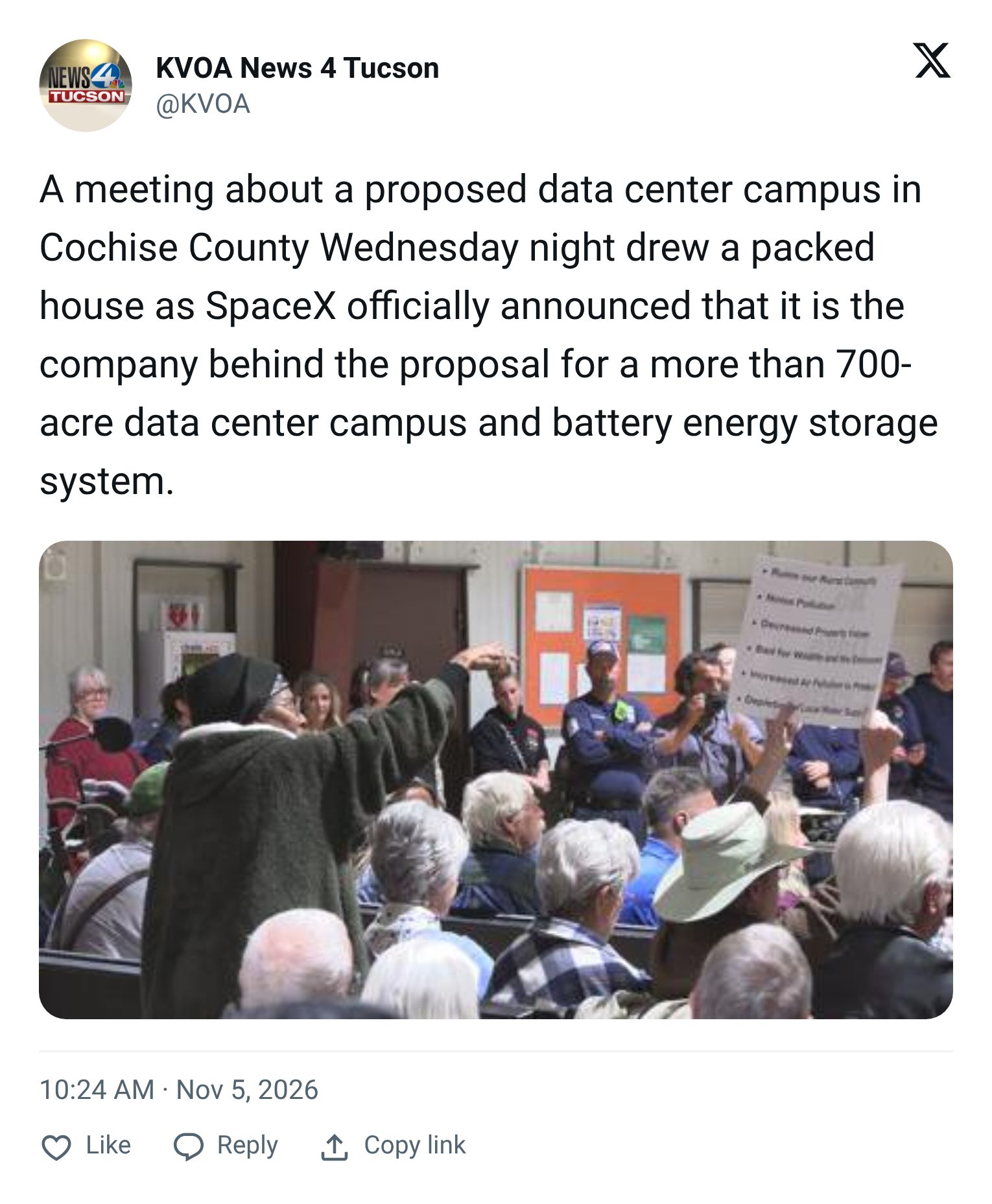
So I know that we are going to have to take some action on data centers, and it may be up to the point of moratorium. It may end up in the negotiation process somewhere less than moratorium, which is fine.
Something I see maybe doing is accounting for (data center) water use and requiring sustainability to be proven. Similarly, with energy use, ensuring that whatever energy use that is required for data centers is for one not contributing to higher electricity rates for ratepayers, as well as not adding to the air pollution burden that people nearby are experiencing. And then other good-neighbor agreements might need to be made in terms of noise, or even in the construction phase to require that they’re having strong labor agreements that use union workers.
TA: I want to tread carefully here and not freak anyone out — but if the state’s water situation deteriorates, can the state just make people use less? You’re seeing cities looking at surcharges and adjusting their Central Arizona Project contract orders. The feds obviously have some ability to compel reductions. What realistically is in the Legislature’s toolbox to say, “Hey, this is an emergency.”?
PS: A lot of what we’re seeing with the rates rising is the recognition that there’s just fewer water sources for cities to be finding, purchasing and making available to their constituents.
Tucson Water’s message has been, you know, “We’ve got this under control, don’t worry.” And I think a lot of that is justified, and it’s because Tucson Water had taken a lot of responsible steps earlier on to put in place block rates, the kind of price signals that you need to start discouraging excess use of water.
Even all of the effort that they did to culturally make it very clear we live in a desert, so we’re not going to be pretending we don’t, and we’re not going to culturally make it common to have lawns everywhere, right? Major props to Tucson for having taken some of those harder decisions at times when it wasn’t as critical as it is now, and for that reason, they’ve been able to kind of keep rates lower in this moment when we’ve seen others have to raise rates because we’re now at the pinch point where finding those additional water resources is coming at a premium.

A xeriscaped yard in Tucson. (Ursula Schuch)
The value of price signals is really important. There are tools that help protect basic-needs uses of water versus larger amounts, and you discourage that by doing things like block rates and making it way more expensive to use excessive amounts of water. Getting to the mandatory cuts piece of it, I mean, that is sort of what underlies a lot of broad management systems (e.g., the AMAs) — we don’t have a lot of water, so we’re not going to approve additional water uses that are excessive.
And when we’re talking about even existing areas where you’ve got significant overdraft, that’s part of why mandatory cuts are part of the rural management topics and legislation — because you’re already in an overdraft. There’s no additional resource to bring in.
TA: Bringing us back to the election — Democrats everywhere ran a lot on affordability. One big part of that is utility rates. At the same time, some water people are like, “Hey, increased water rates are probably coming, and in fact, maybe they should be coming.” So, how do you reconcile the affordability message with the fact that maybe some of the affordability is actually not helpful to the state’s hydrology?
PS: That’s a tough one. That’s going to be the conversation that we have over the course of the whole next year or two. For one thing, our focus on affordability has, for the past year, already included codifying the idea that even many utilities have talked about, which is that growth should pay for growth. Let’s make that enforceable. Let’s really commit to the residents of Arizona that they’re not going to be stuck with the bill for all these large data centers coming on board and requiring new energy to serve them. There’s more conversations to be had on the electric utility bill space — what does ratepayer money get used for?
For water, we’re in a tough place. A lot of places are going to see some rate increase, but there’s also rate structures that can be put into place that could protect the basic needs of residents who live in a household versus the much larger water uses of a much larger water user.
Maybe some of that’s going to have to be crafted by that utility to ensure that we’re protecting regular people while also making it very clear that, okay, if you’re going to use a lot of water, then that does come with the additional cost. I think those price signals again will lead to decisions that end up getting us to the sustainable outcome we need to have.