

Pima County's new leader
Can Allen move the county? … Don't hang out at Home Depot … And better luck in Iowa!
Changing the chair of the Pima County Board of Supervisors rarely draws much attention. Most years, it’s a procedural step: the Democratic majority picks a successor, and the full board votes.
That process played out Tuesday, when Supervisor Jennifer Allen was unanimously chosen to become the next chair, starting in two weeks. The board’s lone Republican, Steve Christy, abstained.
While the chair is a somewhat ceremonial job, it also comes with real responsibilities like setting the agenda, controlling the meetings and acting as the face of Pima County government, during both emergencies and ribbon cuttings.
And it’s not hard to imagine that if Allen — who was one of the chief critics of Project Blue — was in the chairman’s seat last year, things might have gone differently with the secretive planned data center.
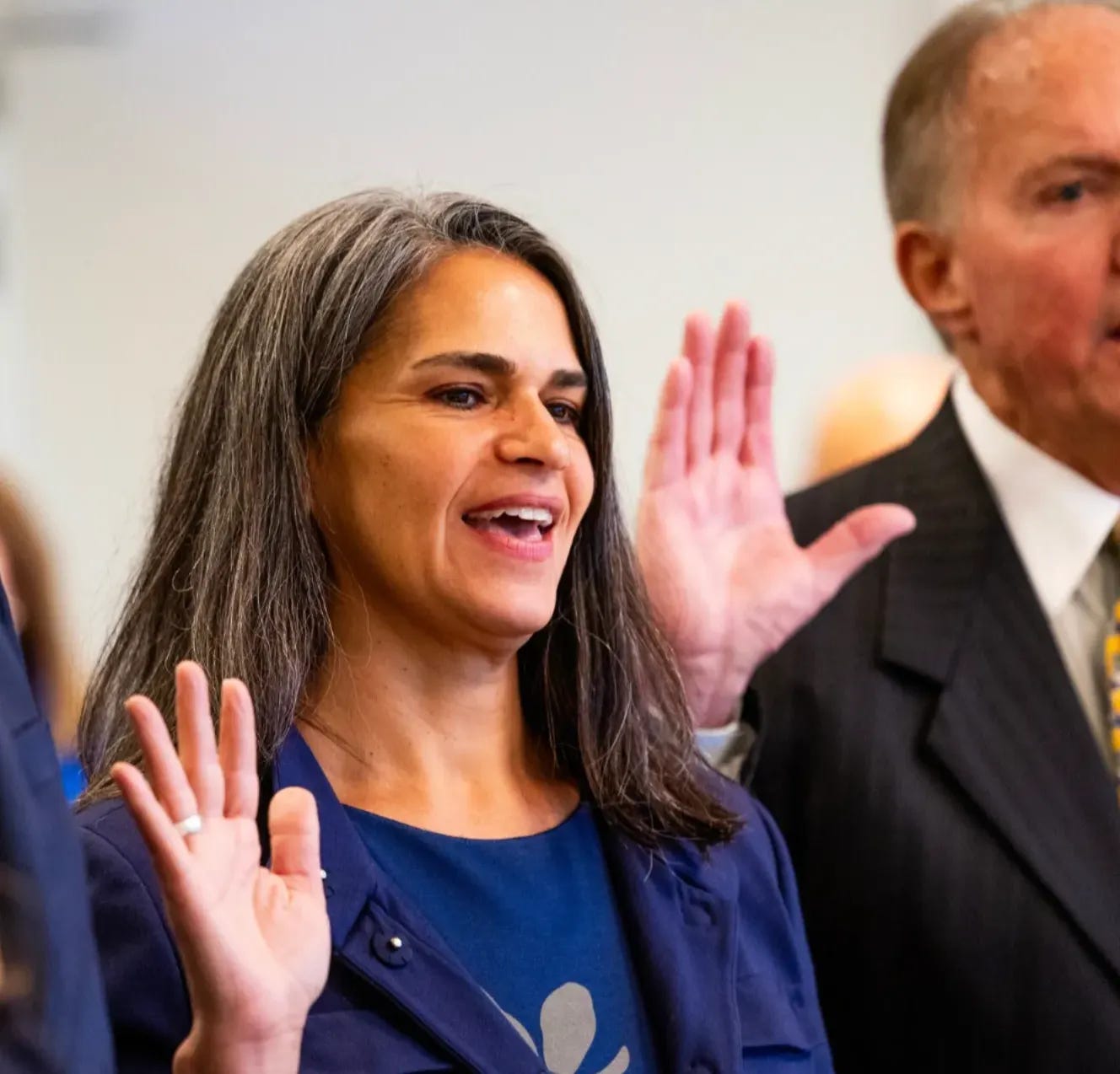
Supervisor Jennifer Allen taking her oath of office last year.We predict that Allen, a freshman on the board, will run a different kind of meeting after spending much of 2025 on the losing side of the fight over selling county land to the developers behind Project Blue.
Those battles demonstrated her unwillingness to bow to powerful interest groups in the business community, labor groups, and even members of her own political party, including two who sit on the board with her.
But she didn’t just spend the year white-knuckling through a fight she couldn’t win. Allen also notched real victories, and she enters the chair’s role well-positioned to lead the county in a new direction.
Take, for instance, her role in ending the county’s nondisclosure agreements (NDAs) with private companies — the same policy that previously hamstrung Allen, the rest of the supervisors and county staff from asking basic questions about a major data center planned in Pima County.
The new policy still allows the county to enter into NDAs — but not at the expense of the public. Under the changes, key information must be disclosed before a public vote is taken.
A lifelong environmentalist, Allen also pushed for — and secured — board approval requiring environmental assessments for developments similar to Project Blue.
What’s next?
The biggest challenge for Allen will be the same one faced by her predecessors: counting to three on hard decisions. Roll call, the pledge, the land acknowledgment, Pause 4 Paws and announcements are the easy part. Everything after that carries the potential for a (mostly friendly) public fight — recorded and livestreamed.
Many of the same headaches from 2025 will carry into 2026, including an uncertain relationship with federal officials, particularly when it comes to grants and other recurring revenue sources.
It’s also an election year, both for county voters and across Arizona — a recipe for some odd political bedfellows. Will Supervisor Andrés Cano face a challenge in this year’s special election? Will voters approve RTA Next this spring — and what happens if they don’t?

Supervisor Andrés Cano will be running in a special election to fill out the last two years of his appointed term.You’d need a crystal ball to predict where the local economy will be in just a few months, and it’s anyone’s guess whether federal enforcement actions seen elsewhere will reach Pima County again — though Allen was front and center during a federal raid on Miracle Mile just weeks ago.
And, of course, everyone would love meetings that last less than eight hours.
New chair, new schedule
Joe may never have another Tuesday night off again. The Pima County Board of Supervisors is changing its meeting schedule to improve public access.
Starting in May, the supervisors will meet on the second and fourth Tuesday of each month, opposite the weeks when the Tucson City Council and Marana Town Council usually meet.
Don’t get caught in traffic, though. The new schedule calls for meetings to start promptly at 5 p.m.
The board will also hold one monthly study session, scheduled for the first meeting of each month at 1:30 p.m.
Same old issues
The $1.2 million in the county’s special revenue contingency fund won’t be tapped — at least not yet — to help cover firefighting costs in South Tucson. At the request of the Pima County Attorney’s Office, the proposal to set aside $300,000 a year has been postponed until next month.
The money would go to the City of Tucson, which has an agreement to respond to structure fires in South Tucson. The county funding would offset those costs.
The general consensus is that you don’t argue about the price of a hose when your neighbor’s house is on fire — but there are still some legal issues to work through.

If you’ve been wondering whether Tucson is ready to trade liberty for security, the Pima County Board of Supervisors has an answer for you.
The four Democrats and one Republican on the board unanimously rejected a $45 million agreement with Axon Industries for the Pima County Sheriff’s Department — a deal that would have locked in costs for the next decade to provide Tasers, body cameras and data services through 2036.
The bipartisan takedown centered on a familiar set of concerns, including wariness over the growing stockpile of data on residents who’ve done nothing wrong — data that could nonetheless be compiled and potentially shared with federal officials.
Other concerns focused on the contract’s growing reliance on artificial intelligence, including the possibility of AI-assisted writing of police reports.

Republican Steve Christy, who noted the contract wasn’t supported by county deputies, said he still supports making sure county employees have the best tools available — just not under this agreement.
Supervisor Andrés Cano noted the county already has an Axon contract in place, but said the proposed agreement went further — adding funding for drones, license plate readers and expanded AI tools — and questioned whether the county should lock itself into such a long-term deal.
The supervisors ultimately directed county administration to send the proposal to the county’s governance committee for review before bringing back any similar contract to the board.
Supervisors asked that any revised contract include the needs of other departments, and that it be open to other vendors besides Axon.

Here they come: The terrorizing tactics used by the Trump administration in cities like Chicago and Los Angeles may have already started in Phoenix, the Republic’s Daniel Gonzales and David Ulloa Jr report. Reporting in recent weeks indicated Phoenix was at the top of the list of Democratic-run cities the Trump administration planned to target next. Other target cities include Minneapolis, where a federal agent shot and killed a woman in her car yesterday. Last weekend, federal agents chased day laborers around a Home Depot parking lot in Phoenix, the first such action during Trump’s second term. They arrested two people, including a 60-year-old man with diabetes who has lived in the U.S. for 30 years.
“He wasn’t a target. They were basically chasing anyone who was running, and he was one of the people who was arrested and thrown to the ground,” Erika Andiola, political director for the National Day Labor Organizing Network, said.

Data centers get green light: The Marana Town Council approved a rezoning request to make way for a 600-acre data center, KGUN’s Madison Thomas reports. That decision came after a four-hour meeting, where more than 50 residents signed up to give the council a piece of their mind. That included both critics of the project and construction workers eager for the jobs the data centers could bring to Marana. The rezoning request came from Fremont Peak Properties, which is owned by Beale Infrastructure, the same company behind Project Blue.
Pushing public power: Tucson Electric Power’s proposed 14% rate increase wasn’t on the Tucson City Council’s meeting agenda on Tuesday, but Tucsonans spoke out against the rate increase anyway, per KGUN’s Vanessa Gongora. Among them was Lee Ziesche of the Tucson Chapter of the Democratic Socialists of America, which is pushing the city to create its own electric utility.
“TEP showed us very clearly in 2025 what will happen if we stick with them. It’s going to be higher bills and supporting data centers and that’s not what the people of Tucson want,” Ziesche said.
Do the people of Tucson want people-powered journalism?
Let us know by clicking this button.
Probably won’t get a warm reception: Bills from GOP state Rep. Nick Kupper would remove speed limits on some of Arizona’s rural highways and lower the age at which people can apply for driver’s permits to 15, which probably won’t sit well with Tucsonans who saw 96 people die in traffic collisions last year, writes Arizona Daily Star columnist Tim Steller.
Not pocket change: The Pima County supervisors voted to send the first big batch of opioid settlement money to local groups dedicated to youth education, addiction recovery and transition services for people recently released from jail, Arizona Public Media’s Nick Rommel reports. They approved spending $3.75 million of the settlement money at their Tuesday meeting, which followed the approval of $1.8 million to fund a detox program last month, at the urging of Tucson officials. Pima County, Tucson, South Tucson and Marana are going to split more than $100 million over the next few years.

Looks like Kari Lake is trading in her leather cowboy boots for rubber farm boots.
The Des Moines Register reports that Lake bought a condo in Davensport, speculating she is looking to start a new political career in Iowa, where she’s from.
We’re so sorry, Iowa!
While we won’t miss Lake, we will always remember fondly the time we made a deepfake of her to help you understand deepfakes.
Our little MAGAt Congressman Juan Ciscomani was NOT one of the nine Republican Congressmen who joined US House Democrats to sign a discharge petition to force the House to have a vote to restore Obamacare subsidies! Ciscomani is the worst Congressman in my 43 years of living in Tucson!!!
Buh-bye Kari! Don’t let the saguaro hit you on the rear on your way out!