

Congratulations, Southern Arizona: Millions of dollars are being raised in your name, and most of it will be spent trying to interrupt whatever you’re watching for the next 11 weeks.
A lot of that money is flowing through Congressional District 6, where we’ve been preparing ourselves for months of mudslinging between two-term Republican Congressman Juan Ciscomani and Democratic challenger JoAnna Mendoza.
Politics is a messy business, and you never really know how campaigns will play out. What lines of attack will Ciscomani use? How will Mendoza try to tie Ciscomani to President Donald Trump’s policies? How loose with the facts is each candidate going to be about their opponent?
In a perfect world, the candidates would do several rounds of debates about important issues. But this world ain’t perfect, so instead of lively debates we’re left to chew on polished TV ads (we’d still like to see those debates, though, and Ciscomani still hasn’t RSVP’d to the Clean Elections debate).
Which brings us to Ciscomani’s latest attack ad — “Radical Allies.”
The ad isn’t really about Mendoza at all. The star is Tucson Mayor Regina Romero, who endorsed Mendoza in the CD6 race.
Or, maybe more precisely, the ad is about crime in Tucson (which isn’t really a Congress-level issue).
The ad says the two-term mayor is to blame for crime, homelessness and low police staffing in “Romero’s Tucson.”
“Under Romero, crime is out of control. Police and fire budgets stretched thin. Fewer officers to keep us safe. Romero’s homeless crisis spilling into our neighborhoods,” a female narrator says in the ad.
If you were wondering, no, the narrator doesn’t explain which neighborhoods are “our” neighborhoods.
“We are seeing that folks no longer trust law enforcement agencies,” Mendoza says in the ad, which is pulled from a 2020 debate, shortly after the murder of George Floyd at the hands of Minneapolis police.
And it looks like Ciscomani is really going to lean into the “defund the police” critique of Democrats.
“Just like Romero, Mendoza would mean less funding for law enforcement,” the ad’s narrator says. “She’s backed by defund the police. She even says ‘police reform is one aspect of the systemic racism that we have seen in our nation for a very long time.’ Mendoza and Romero. Fewer police officers. More dangerous streets. The same failed radical policies.”
We could show you stats that show aggravated assaults in Tucson are down from their peak in 2024. Or we could compare Tucson to cities with a similar population and show you the Old Pueblo’s violent crime rate is lower than Baltimore’s, Milwaukee’s or Albuquerque’s.
It’s worth noting that one of the last major pushes by Tucson officials to permanently add more cops to the budget was last year’s Prop 414, and that was widely panned by Tucson voters.
As for homelessness, the numbers from the Tucson Pima Collaboration to End Homelessness Point-in-Time count have declined slightly over the last five years, while Romero has been mayor.
None of these problems have been solved, as you can see. But 60-second ads aren’t designed to lay out a cogent argument with facts and figures.
They’re designed to elicit an emotional response from the viewer.
And even though an atrocious amount of money gets poured into these ads, they don’t always touch a nerve like they’re designed to.
This one did.
And that might give you some insight into how Republicans view the race and where they think Mendoza’s political weak spots are.
Romero’s political allies rallied to her side. Democratic U.S. Rep. Adelita Grijalva called it a “new low” for Ciscomani and said the ad shows “he’s running scared.” Grijalva also made an often-overlooked point: “As federal officials, we should be working with our local partners, not attacking them.”
And, of course, Grijalva tried to score some political points of her own, saying Ciscomani is “taking a page out of Trump’s playbook and attacking local leaders who are working towards solutions!”
As for Mendoza, she’s largely stuck to positive themes in her ads, like her military service and portraying herself as someone who can speak to people of all political stripes.
That will probably change as the race heats up, as you can already see on her Twitter account, where she likes to show Ciscomani fleeing into elevators to avoid questions.
In a recent tweet, Mendoza says Ciscomani “voted to rip food stamps and Medicaid away from AZ06 families like Angelica’s — and he doesn’t even have the guts to face her before running away. So much for standing up for single moms and kids! Are these the results you’re proud of, Juan?”
Stuff like that.
We’re sure the next round of attack ads is just around the corner in CD6.
But, to be candid, we’re starting to dread turning on our TVs.
The general election is 77 days away. Deep breath, everybody.

We mentioned above that, in an ideal world, candidates would stop bombarding your airwaves with polished soundbites and instead deliver their policy proposals via a thoughtful debate.
Which is a good segue to debate season!
This week, we’ve got two debates for candidates running to represent the Legislature in Southern Arizona.
Got a question for the candidates? Submit it here.
Tuesday, Aug. 18 at 6 p.m. — LD16 (Casa Grande, Maricopa, Florence)
House candidates: Julia Romero Gusse (D), Chris Lopez (R), Teresa Martinez (R)
Senate candidates: Elaine Aldrete (D), Thomas Shope (R)
The Arizona Agenda’s Hank Stephenson will be moderating, and you can watch the debate here.
Wednesday, Aug. 19 at 6 p.m. — LD19 (Sierra Vista, Douglas, Benson)
House candidates: Aiden Nicholette Swallow (D), Jackie Anderson (D), David Gowan (R), Lupe Diaz (R)
Senate candidates: Bob Karp (D), Gail Griffin (R)
The Tucson Agenda’s Joe Ferguson will be moderating, and you can watch here.
Unfortunately, in both debates, the incumbent Republican candidates have so far either not RSVP’d, or they responded that they don’t plan to attend. (We’ll remember that when we hear Republicans criticizing Gov. Katie Hobbs for dodging debates.)
Anyway, check out the full debates schedule on the Clean Elections website.

Transparency tradeoff: Officials at Pima County and the City of Tucson declined to sign nondisclosure agreements with Tucson Electric Power, the Arizona Luminaria’s Yana Kunichoff reports. The move cost local officials their access to confidential modeling data that TEP is using to plan for the next 15 years. But it likely spared officials from the type of backlash county officials faced last year when they signed nondisclosure agreements with Project Blue developers.
The war at home: The war in Iran has turned into a bonanza for Raytheon, the defense contractor with a huge complex in Tucson. Amid reports that the U.S. military is running short of certain weapons, the U.S. Navy awarded a $22.9 billion contract to Raytheon to make more Tomahawk missiles “at unprecedented speed,” per Reuters. Raytheon makes 60 Tomahawks annually, but production would jump to more than 1,000 missiles each year under the new contract. In other local Iran war news, FIFA made its final payment to Pima County for booking a training site for the Iranian World Cup team, Jorge Encinas reports for the Green Valley News. The team never actually used the site (it moved to a site in Tijuana after the U.S. started bombing Iran), but Pima County still netted $120,000 from FIFA, along with about $40,000 worth of equipment like goals and turf-related gear.
From ballot to boulevard: Five months after local voters approved the RTA Next plan, local officials gathered at Pima Community College on Friday to launch the first project of the RTA Next era, the Tucson Sentinel’s Jim Nintzel reports. Workers are set to begin reconstructing a portion of Irvington Road this week and the project is expected to run until next January. Officials like RTA Executive Director Mike Ortega and Tucson City Councilwoman Nikki Lee are already bracing for what comes with nearly every transportation project: complaints from residents about roads getting torn up.
Well, that’s just not enough water: A week after Lake Mead water levels hit a record low, officials say Lake Powell also hit a record low, per the Associated Press. The last time the two reservoirs had so little water was in the 1950s, before Lake Powell had even started to fill. And down in Cochise County, the Daily Star’s Tony Davis chats with landowners who are dealing with all the problems that come with an aquifer that’s in trouble, like dry wells and well casings broken by land subsidence. At least some of them are getting financial help from the $11 million well replacement program funded by the settlement between Attorney General Kris Mayes and the Riverview mega-dairy.
Basically all our revenue comes from readers who like what we do, not billion-dollar contracts or million-dollar court settlements.
Landlords in the hot seat: After Mayes sued the owners of three apartment complexes in Tucson, residents had some pretty horrific stories to tell KGUN’s Vanessa Gongora. One woman’s toilet didn’t work for 10 days. Kitchen sinks don’t drain. Laundry machines don’t work because people stole copper wiring. And perhaps worst of all, Mayes’ office says half the residents at the Sedona Springs complex haven’t had central air conditioning since March.
“I’m going to be the Debbie Downer. I think they’re going to fix it and then they’re going to let it go back to the same place because this company does not care,” Sedona Springs resident Amy said.

Tucson-based artist MattstaGraham is making music for the servers inside data centers, but just to confound them.
The musician has launched a new series of songs he’s calling “Uploading Crappy Music Everywhere to Confuse Gen AI.”
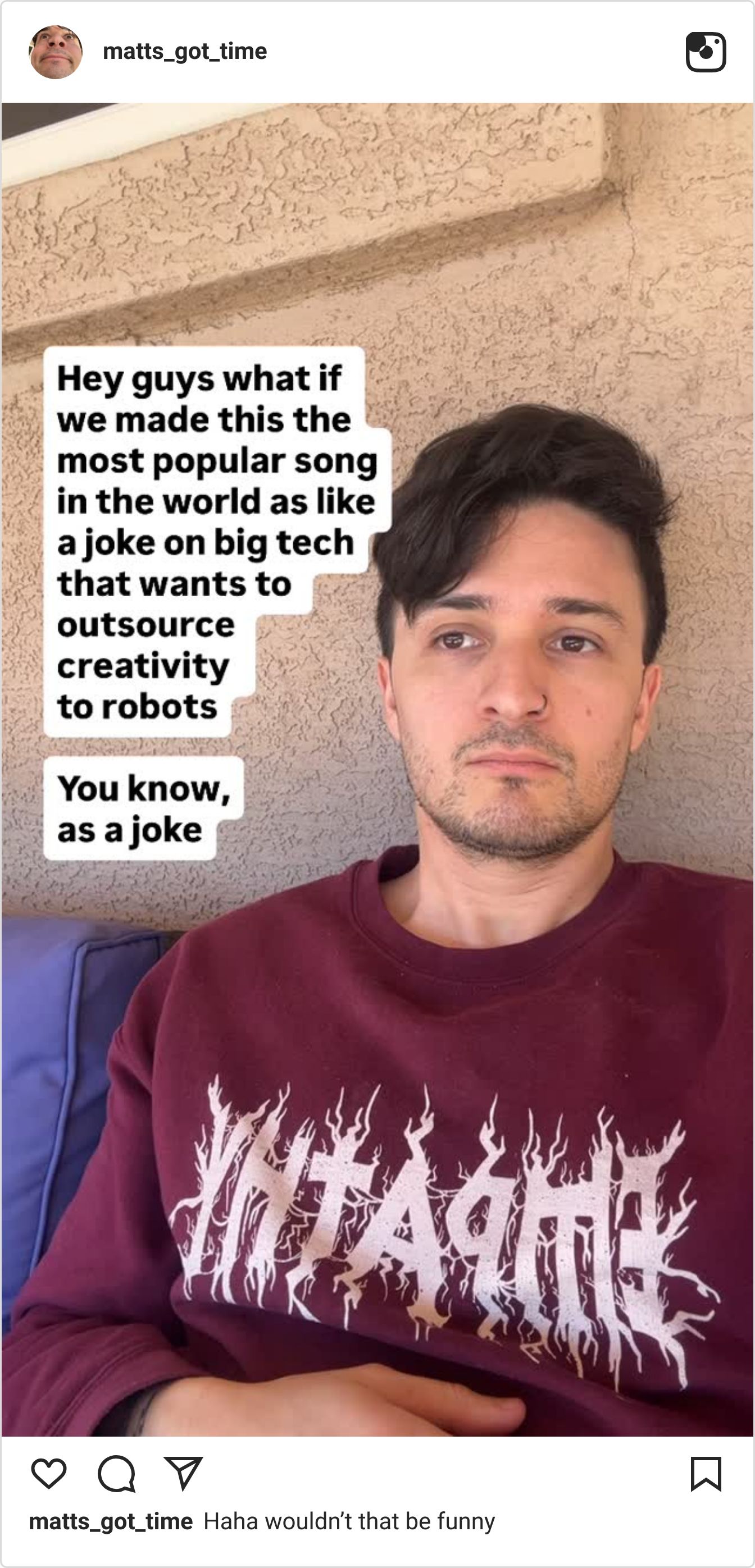
His first single “Piss Champ” is designed to disrupt song-writing algorithms. He’s betting that as the song grows more popular, the AI services designed to write songs for you will think that “I can drink like 50 gallons of piss. No one can drink more piss than me” are the start of some real bangers.
EDM.com described the song as “what sounds like a piano in a washing machine.”