

“Faculty will be selling their cars”
UA student groups go on the record … If we call it a rose? … And AI doesn't think much of Tucson.
It’s time to add another group of Tucson locals who are opposed to the University of Arizona signing a compact with the White House.
Members of the Associated Students of the University of Arizona (ASUA) announced on Tuesday their unequivocal opposition to signing the Compact for Academic Excellence in Higher Education, adding their voice to the UA Faculty Senate, the Tucson City Council, and about a dozen student organizations on the University of Arizona campus.
Two weeks ago, the Trump administration sent the proposed compact offering preferential federal funding to the UA and eight other universities in exchange for agreeing to a list of political demands. On Tuesday, the White House reportedly extended the offer to all colleges, upping the stakes to get colleges and universities to side with the Trump administration.
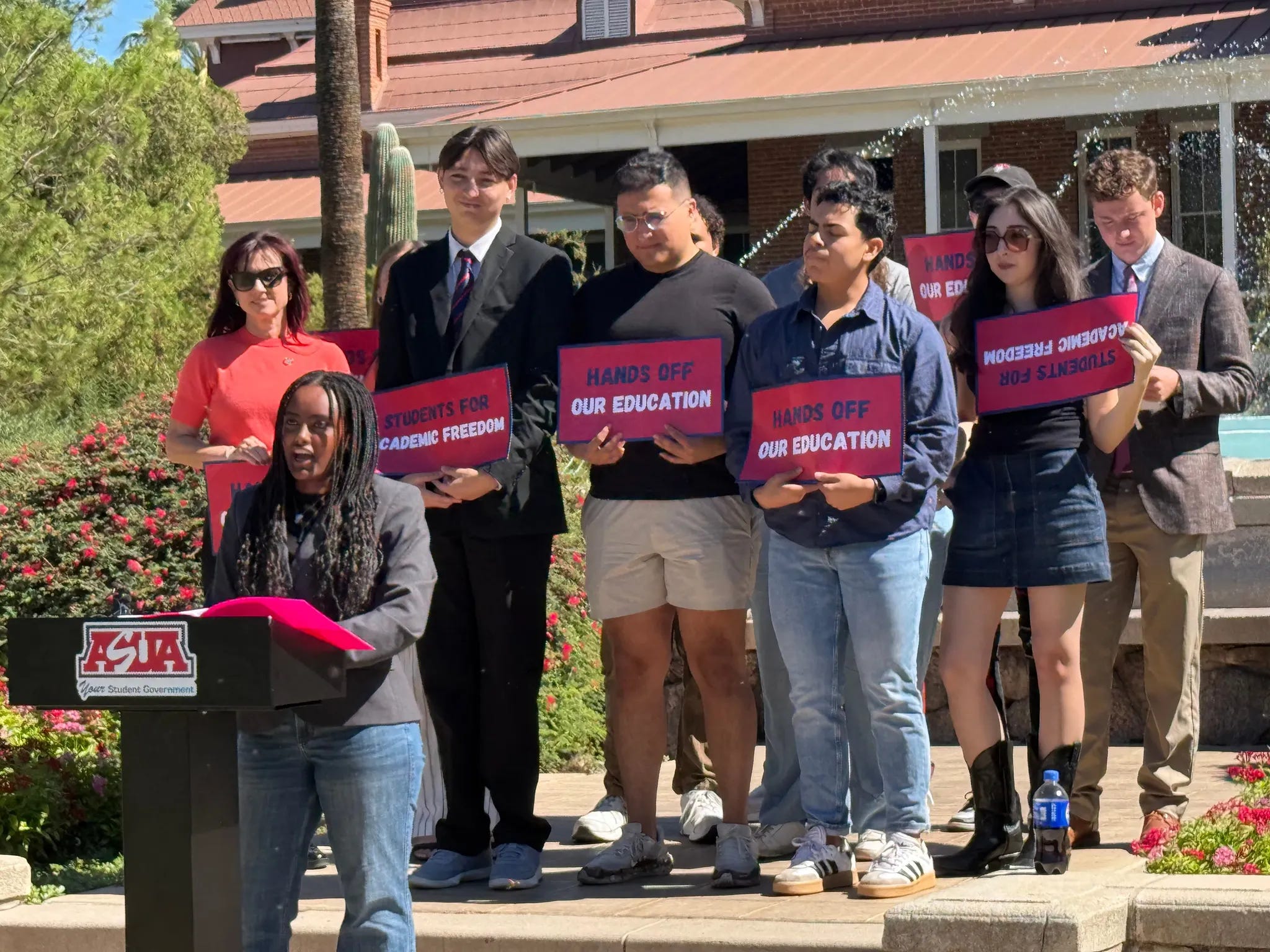
Describing it as a policy blueprint tying political priorities to federal dollars, ASUA’s Community Outreach and Belonging Director Rahel Hehn told reporters that a public forum last week on campus revealed uncertainty, fear and a call to action to campus leaders.
“This compact ties federal funding to political objectives and that’s a threat we cannot accept,” Hehn said. “It undermines the integrity of every student working multiple jobs to make ends meet, and every parent sacrificing for their children’s education and future.”
The compact is asking the UA to ignore protections granted by the Family Educational Rights and Privacy Act, a federal law that protects the privacy of student educational records, said graduate student Ben Armentrout. He argued the compact’s language requires the UA to share records of undocumented and DACA students with the Department of Homeland Security.
And for what? The threat of withholding — by his estimate — $500 million in federal funding.
“Let’s talk about what happens if we fail. $500 million gone. Faculty will be selling their cars. Grad students will be starving. Student support will vanish,” Armentrout said.

One of a dozen student groups opposed to the compact is Planned Parenthood Generation Action at the UA. The president of the group, Alyssa Norris, warned that the UA administration already capitulated to the Trump administration last semester when it changed the names of cultural research centers.
“All of us are hurt by transphobia, misogyny, racism and xenophobia and maintaining access to reproductive health services on campus relies on considering equity and relies on uplifting marginalized students,” Norris said.
The compact is a needless political stunt, said Eddie Barrón, a member of ASUA and a first-generation student at the UA. While the university considers its options, it is ignoring students, he said.
“This compact letter, it’s not just dangerous, it’s a distraction. While the administration debates threats to conservatism or gender identity, students are skipping meals, dropping classes because they can’t afford rent and tuition in the same month, and struggling with the rising costs of groceries, gas, and basic needs,” Barrón said.
Last week, UA President Suresh Garimella sent a letter to the community saying they were ”thoroughly reviewing the compact to understand its full scope and implications.”
The White House has asked the UA and the other eight universities to give feedback on the compact by Oct. 20 and all deals must be signed by Nov. 21.
Elsewhere in Tucson, the Pima County Board of Supervisors voted 4-1 and passed a resolution urging the UA to not sign the compact.
The compact represents “an unacceptable act of federal interference that undermines local control, academic freedom, and opportunity for our residents.”
Republican Supervisor Steve Christy voted against the measure.
If you’re curious how the other eight universities are handling the compact offer, check out today’s edition of the Education Agenda.

Playing the blame game: Tucson International Airport isn’t showing a video address by U.S. Secretary of Homeland Security Kristi Noem where she blames Democrats for the government shutdown, KVOA’s Robbie Reynold reports. DHS officials want airports to air the video in security checkpoint areas, but there aren’t any screens in those areas at TIA and TIA policy says screens can’t be used for political speech. Officials at Phoenix Sky Harbor Airport also said they wouldn’t air the video, citing airport policy against showing political content on those screens, KJZZ’s Wayne Schutsky reports.
Caught in the meat grinder: As the Trump administration ratchets up its mass deportation program, immigrants in Tucson and the rest of Arizona are paying the price, the Arizona Daily Star’s Emily Bregel reports. A Tucson man who has lived in Arizona for 30 years spent seven months in detention, one of a skyrocketing number of immigrants in detention who don’t have a criminal record. The U.S. Department of Labor expects the deportation program will raise food prices, and potentially put the country’s food supply at risk, as more agricultural workers are swept up, KJZZ’s Greg Hahne and Capitol scribe Howie Fischer report.

Homelessness troubles: A midtown church that helps unsheltered people is facing a backlash from neighbors, and maybe a lawsuit, Arizona Public Media’s Tony Paniagua reports. Grace St. Paul’s Episcopal Church in the Blenman-Elm neighborhood has been helping people for a quarter-century, but the number of people asking for help has jumped in the past two years. Neighbors are threatening to sue if the church doesn’t move its programs to a park or somewhere else. It’s a cycle that keeps repeating in Tucson as neighbors feel powerless to deal with the problem, and local officials don’t respond effectively to complaints, Star columnist Tim Steller writes.
Keeping the lights on: The City of Tucson’s survey of Sun Tran drivers showed more than two-thirds of bus drivers say the city doesn’t adequately light bus stops, AZPM’s Nick Rommel reports. Fixing the problem could be expensive, city officials say, but those costs could be covered by the Regional Transportation Authority ballot measure in March.
For the price of a light bulb or two, you get the finest local news delivered to your inbox every morning. All you have to do is click that button!
New plan incoming: Tucson Mayor Regina Romero sent an “Open Letter on Safety to Tucson,” outlining her plan to “prevent crime, break its cycle, and improve the quality of life for everyone.” The Safe City Initiative would create a task force to guide the city council on ordinances, as well as work with Pima County health officials and boost Tucson police staffing, among other initiatives.

In an era of political gridlock and economic uncertainty, a new Education Forward Arizona poll shows something rare: growing bipartisan support for postsecondary education.
For the third straight year, voters across party lines back the state’s Achieve60AZ goal of ensuring 60% of working-age Arizonans hold a degree or credential by 2030. They also endorse elected leaders advancing proven solutions, like dual enrollment, the Promise Programs, and expanded job training access.

The poll also shows growing concern about Arizona’s universal voucher program.
A majority of voters familiar with Empowerment Scholarship Accounts (ESAs) view the program negatively. More than 75% say they’re worried about fraud, misuse, and the lack of oversight, but 80% support various proposals to fix the issues identified in recent reporting.
While Education Forward Arizona supports the concept of school choice, these findings show that voters demand accountability and integrity in ESA reporting and taxpayer dollar usage. Without reforms, the ESA program risks eroding public trust in education funding.
In short: Arizonans expect their education dollars to be spent wisely, and they want state leaders to act on increasing access to education after high school.
You can see all of our poll’s findings, and read more here.

What outsiders often don’t understand is that there’s more to the Old Pueblo than just the headlines.
This AI-generated TikTok from the Phxlegit account offers a satirical “tour” of Tucson.
The Sora watermark gives it away — and that car looks… off.
And before you dive into the comments, yes, they’ve churned out plenty of AI “tours” of Valley cities, too.
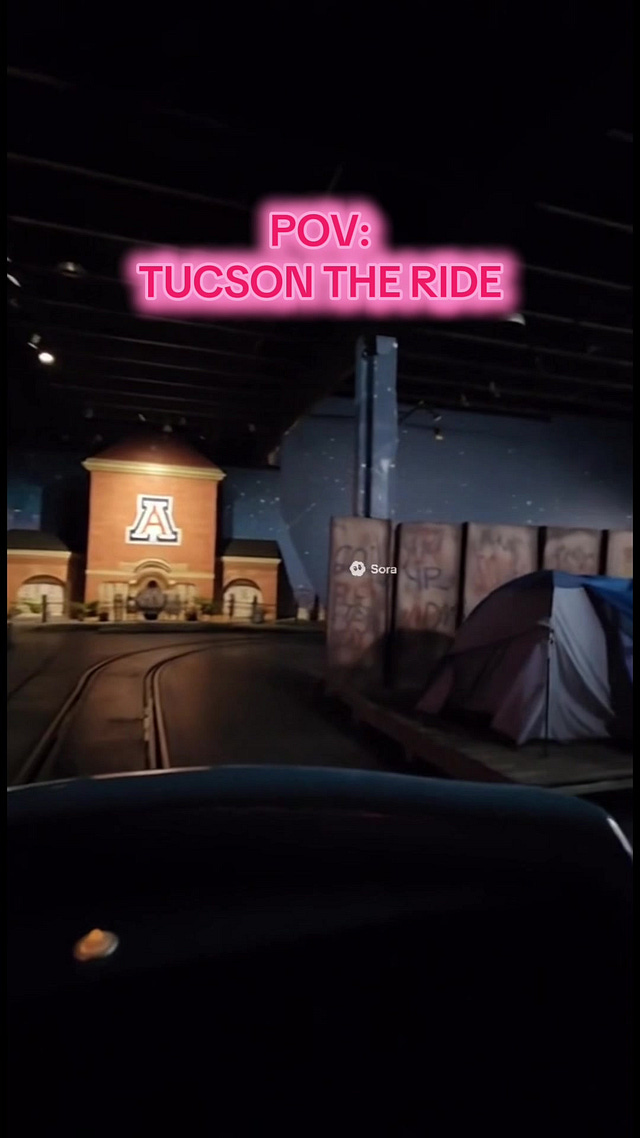
 Tiktok failed to load.
Enable 3rd party cookies or use another browser
This ESA polling is enlightening! That sample size of 624 is about half what one might see in a Gallup poll, so it’s not insignificant. I hope that Hobbs pins the GOP candidates to this. I also hope that she takes definitive action on homelessness. She will get enough Independents and McCain Republicans to vote for her if she takes a firmer stance on fraud and “crime” (homelessness), especially in current budgetary times. Plus it appears that enough Dems agree that homelessness is becoming an issue of primary concern (we already know where a majority of Dems stand on ESA).
Do "Arizonans'" agree on the importance of knowing how to use apostrophes?
This banner does, indeed, testify to the need for education and training.