


It was only a matter of time before the Border Patrol threw a temper tantrum.
Last year, agents were rampaging through cities like Chicago and Minneapolis. They rappelled from Black Hawk helicopters, arrested children and nonchalantly threw tear gas at people in quiet neighborhoods.
The public backlash was huge, especially after federal agents gunned down two people in Minneapolis. The outrage ended the career of Greg Bovino, the wackjob Border Patrol commander leading agents from city to city.
All the while, Arizona’s border with Mexico has been quiet. A handful of migrants are caught crossing the border each day and the Trump administration is steadily moving ahead with the construction of a double-layered border wall.
The only fly in the ointment, so to speak, was protesters trying to stop border wall construction.
There were a few flare-ups in recent weeks, such as the arrests of protesters dressed as endangered animals near the wall in Cochise County and the U.S. Forest Service closing down the road that runs along the border for the next two years.
The dam burst on Monday when dozens of Border Patrol agents — dressed in that military-ish garb they seem to love — arrested protesters in Lochiel who were trying to protect ancient cottonwood trees and slow down border wall construction.
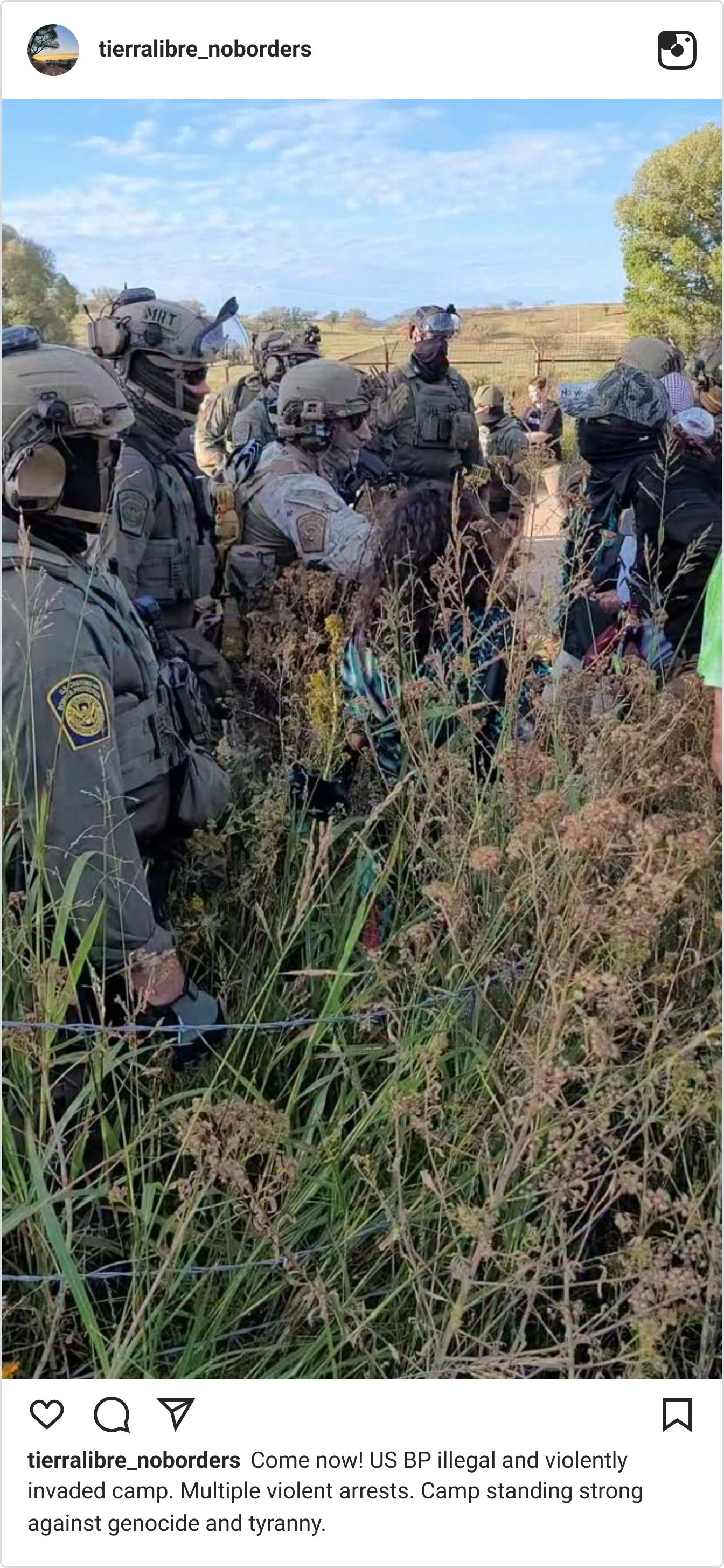
The Lochiel protesters, speaking under the banner of Tierra Libre Lochiel, gave a harrowing — yet all-too-familiar — account of what happened:
“Ignoring demands to present a warrant, the agents invaded camp at 6:30 AM. They began destroying tents with badges covered, refusing to share their names and aggressively forcing land defenders away from the Grandmother Tree defenders were gathered around for a sunrise ceremony,” Tierra Libre Lochiel wrote in a news release.
“Defenders on the ground estimate at least 12 have been arrested so far. Border Patrol agents have begun to make cuts to the ancient tree, critically endangering the tree and the land defender high in its branches. Agents assaulted and tackled land defenders, some who stood in as protective presence aside the tree. Agents even pushed land defenders into a barbed-wire fence, and (they) are being treated for injuries. Several others had their necks stomped on by agents.”
Longtime Southern Arizona residents may remember hearing similar accounts from the many times Border Patrol agents went after humanitarian volunteers, including the high-profile raid on a No More Deaths building in Ajo in 2018.
The arrests in Ajo led to a long legal drama as aid volunteers claimed they were acting on sincerely held religious beliefs.
But something big has changed since 2018, and it could alter the state of play if federal prosecutors bring charges against the Lochiel protesters.

The Lochiel protesters holding a press conference in Tucson after the Monday morning arrests.
Back then, we were only two years into the first Trump administration, and federal judges still treated the Border Patrol as a reliable narrator of events, under a principle known as the presumption of regularity. Basically, courts are supposed to assume that the government isn’t lying.
But that credibility was shredded over and over again last year as judges got fed up with federal agencies and called them out for lying.
The best-known example came last November, when U.S. District Court Judge Sara L. Ellis eviscerated the claim by Border Patrol agents in Chicago that they were fighting an organized, violent resistance, when in fact they were terrorizing peaceful neighborhoods.
Federal agencies “would have people believe instead that the Chicagoland area is in a vise hold of violence, ransacked by rioters, and attacked by agitators – which justifies the unprecedented swath of indiscriminate uses of force unleashed on journalists, peaceful protestors, and religious practitioners,” Ellis wrote in her order. “That narrative simply is untrue.”
Ellis went on to say the evidence presented by federal agencies is “simply not credible” and they “cannot simply create their own narrative of what happened, misrepresenting the evidence to justify their actions.”
In the world of judicial decorum and restraint, those words land like thunderclaps. Federal judges don’t say that type of thing unless the evidence is overwhelming.
The Border Patrol wasn’t the only agency to get called out, either.
Just last month, U.S. District Court Judge Brian E. Murphy said ICE was no longer entitled to the presumption of regularity in his Boston courtroom. He cited a “litany of deception and outright falsehoods” from the agency.
“This Court is under the disheartening impression that, at best, ICE takes cursory steps to ensure that its statements are truthful, and, at worst, has a culture of outright lying to further its litigation positions,” Murphy said.
The question we’re pondering as we watch the Lochiel incident unfold is how federal judges in Southern Arizona will treat the Border Patrol’s credibility.
Will they give the Border Patrol the benefit of the doubt? Or a big helping of side-eye?
We don’t envy the position those judges are going to be in. They’re on the cusp of a big test that could end up being a whirlwind of falsehoods from an agency they’re supposed to trust.

On the home stretch: Republican U.S. Rep. Juan Ciscomani made Fort Huachuca and the economic development that comes with the base, including a possible Space Force mission based there, the centerpiece of his remarks at the Sierra Vista Golf Center, the Herald/Review’s Matt Hickman reports. Bringing federal dollars and economic development to Cochise County is a big part of Ciscomani’s pitch to voters ahead of the election. As for another big economic topic of the moment, data centers, he said local communities should “have the final say.”
Settlement offers clues: A divorce case offers new details about the secretive Global Community Communications Alliance religious sect in Santa Cruz County, Dan Shearer writes in the Nogales International. The court fight between former member Amanda Steinhardt and her still-member husband Daniel Steinhardt centered on whether the community is an acceptable environment for children, and includes a 126-page report ordered by a judge on the children’s education, parenting style and their safety.
Putting schools in a box: Prop 320, the ballot measure authored by Republicans in the state Legislature, is a bad deal for rural residents, Cochise County School Superintendent Jacqui Clay writes in the Herald/Review. The one-size-fits-all approach doesn’t work in smaller rural schools that need to spend a big part of their budget outside the classroom. Prop 320 requires 60% of a school district’s budget be spent on “direct instructional expenses” and punishes schools that fail to meet the standard by cutting state funding.
“Our schools do not begin and end at the classroom door. Students need teachers, but they also need counselors who support mental health, nurses who keep them safe, bus drivers who get them to school, and specialists who serve students with disabilities. They need buildings that are clean, secure and climate-controlled,” Clay writes. “None of these essential services count toward the 60% requirement, and many districts would be forced to cut them to comply.”
That’s quite a list: As sales stagnate along North Fourth Avenue, business owners are pointing to city officials making it more expensive to park as the culprit. But Arizona Daily Star columnist Tim Steller says they should consider a nationwide drop in consumer confidence, fewer University of Arizona students, a decline in tourism from Canada, a focus by Rio Nuevo on downtown development instead of on Fourth Ave and more “bothersome street behavior.”
Don’t house people in this neighborhood: Residents in the Keeling neighborhood are concerned about a proposal to increase the size of a pilot program housing homeless people in micro houses, KGUN’s JJ McKinney reports. The Homing Project is planning to expand from 10 to 20 units to give shelter to unhoused people, but neighbors want the Homing Project to take more time with just 10 units before doing anything that could disrupt the neighborhood.

Beyond the Ballot AZ is a weekly show about legendary Arizonans, notable — and sometimes notorious — political events, and the social movements still shaping the arguments we’re having today.
A resource of the Arizona Citizens Clean Elections Commission, hosted by Executive Director Tom Collins and Director of Voter Education Gina Roberts, who break down what’s happening and how you can actually get involved in it. Same state you’ve been reading about all morning, with a lot more context.


How much do you think the guy running the City of Tucson makes every year?
We choked on our Cheerios when we saw City Manager Tim Thomure makes $324,500 a year.
We get that it’s a hard job and whatnot, but holy moly that’s a lot of money.
And at tonight’s Tucson City Council meeting, he’s probably going to get a nice raise — to $375,000 — as his current two-year contract comes to an end.