

Incoming (and returning) state lawmakers from Southern Arizona should make some room on their phones for new voicemails.
Their elected Democratic colleagues on the Pima County Board of Supervisors and the Tucson City Council will be calling very, very soon.
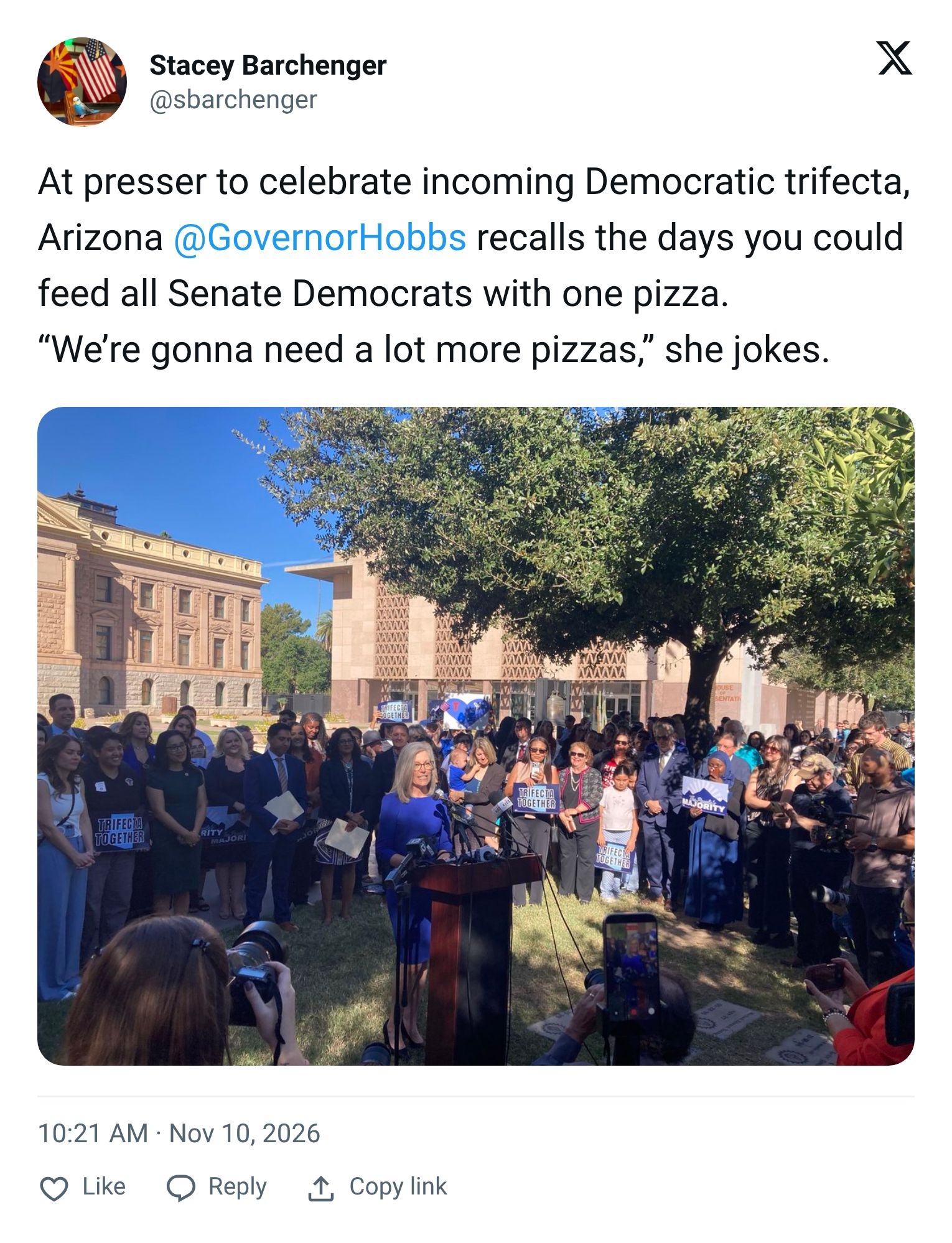
The potential for change with Democrats poised to control both legislative chambers and the governor’s office has local politicians scrapping at least some of the legislative priorities they set this summer when Republicans controlled both chambers of the Legislature.
It’s time to go on the offensive, several elected officials told the Tucson Agenda this week.

Four of the new leaders in the Arizona Senate — Sundareshan, Hernandez, Soto and Gabaldon — are Democrats from Southern Arizona.
Pima County Supervisor Matt Heinz — who served two terms as a state representative — had a long list of priorities for his Democratic peers at the Legislature.
Democrats should push forward what Heinz labeled as a "good governance" package, adopting a series of reforms that mirror laws in other states. His list includes allowing same-day voter registration, permanently ending tax breaks for data centers and making sensible changes to some state-mandated public health policies.
Heinz referred back to laws he voted against during his time in the Legislature from 2009 to 2013, suggesting Dems could hold a series of special sessions next year, including one on water and another that he calls a repeal-athon dedicated to scrapping laws still on the books.
The state’s 2.5% flat income tax rate should be abolished as well, but he conceded that securing the votes needed to repeal it would require some Republican support.
The state could also consider increasing its gasoline tax, which hasn’t changed in decades, to help repair and maintain roads.
“A new gas tax isn’t going be very popular,” he conceded. “But people also don't like ambulance-sized potholes.”
His Democratic colleague, Supervisor Rex Scott, is concerned about the state shifting costs to the counties.
Roughly 25% of the last property tax increase was directly tied to the state shifting more health care and court costs onto the county, Scott said.
“It's not just Pima County that deals with those, it's also the other fourteen counties,” Scott said, arguing “red” and “blue” counties are struggling with ways to absorb those costs.
Scott said the current tax formulas essentially punish Pima County for having so many residents in unincorporated areas.
One solution might be to revisit conversations about increasing the gas tax, instead of trying to tinker with complicated statewide tax policies.

Arizona has one of the lowest gas taxes in the nation.
If communities like Vail and Green Valley chose to incorporate, he noted, it would bring more funding to the region — but he said that decision should rest with residents of those communities.
Tucson City Council member Paul Cunningham has long argued that the city and county should encourage those communities to incorporate.
Under the current revenue-sharing rules, he argues, incorporation would bring more money into the region — including pooled funding for regional projects like roads.
By remaining unincorporated, those communities are leaving money on the table.
He also suggested special taxing districts as a possible middle ground, allowing residents to fund particular services without taking on the costs of a full municipal government.
Repealing the flat tax is another item on Cunningham’s wish list.
He called it a long-term barrier to funding the most basic city services, arguing Arizona should return to the tax rates in place before former Gov. Doug Ducey and the Republican-dominated Legislature passed the flat tax.
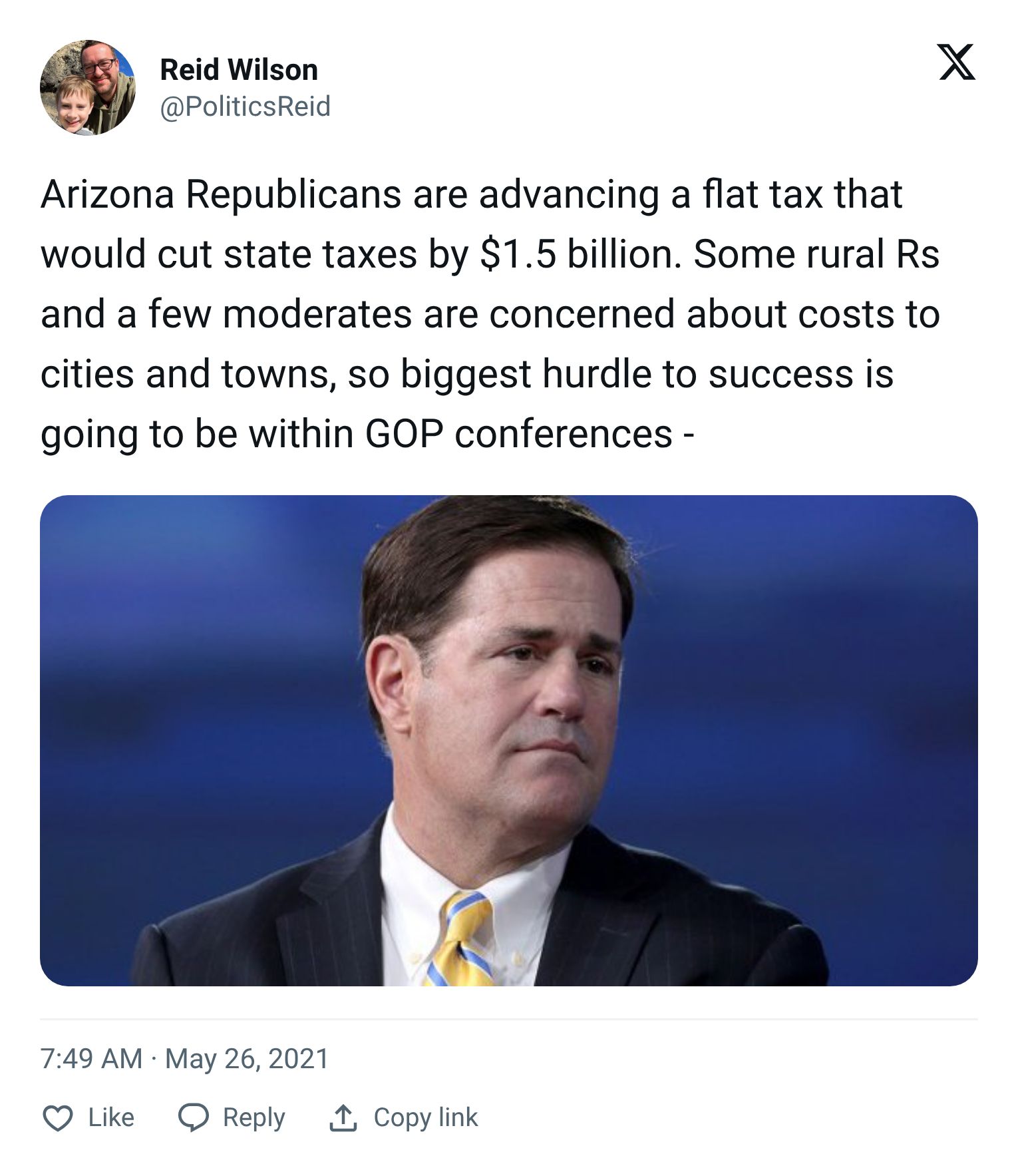
Pima County Supervisor Jennifer Allen said economic forecasts suggest the flat tax will hurt more and more in the future.
“We have not yet felt the full impact of the flat tax, and that our budget is going to get hit harder and harder over this coming fiscal year and the next fiscal year,” she said. “State revenues will be decreasing and then therefore more things get pushed onto us.”
Allen has also publicly called for challenging Prop 207, aka the 2006 Private Property Rights Protection Act. The voter-approved law allows property owners to sue over diminished property values caused by new land-use laws.
She argues the law has had a chilling effect on local government, including efforts to restrict large-scale data centers.
It’s a shame that the board of supervisors and the council canceled their joint meeting scheduled for next week.
It seems like they have a lot to talk about.

Despite objections from county employee groups, the Pima County Board of Supervisors sided with the Pima County Attorney’s Office on a request to rewrite part of the merit commission rulebook.
Both the American Federation of State, County and Municipal Employees (AFSCME) Local 449 and the Pima Corrections Association opposed amending Merit System Rule 14, which requires the "just cause" standard to be considered when county employees appeal their terminations.
Mike Hellon, the chair of the county's merit system commission, said the rules help ensure the county treats employees equally.
He described an example of a “personal vendetta” in which a supervisor suspended an employee for hanging a framed letter of reprimand on his office wall, even though another employee had done exactly the same thing.
“Are we supposed to overlook that?” Hellon asked.
Sam Brown, chief civil deputy county attorney, told the supervisors that employee groups were trying to make the proposal political.
“There have been some attempts to impugn our office or (Pima County Attorney) Laura Conover herself. This is stemming from a situation where 37 of 38 hearings, (only) one has had an appeal denied on the merits from the merit commission, which means 37 times the merit commission has found against the county,” Brown said during the meeting.
Brown serves as legal adviser to the board, but said his office would have made the same request if the merit commission had sided with the county in 37 out of 38 cases instead.
Cassaundra King with AFSCME told us after the meeting that the supervisors were making a mistake.
“I believe that this amendment is a step backward in employee protection,” King said.
The union, which represents most Pima County employees, will work with the County Attorney’s Office to find ways to balance the new rule with protections for county employees, she said.

This land is their land: Arizona’s Senate delegation was divided on legislation that could allow the controversial Copper World mining operation to put waste rock and tailings on Coronado National Forest land in the Santa Rita Mountains, the Arizona Daily Star’s Tony Davis writes. Sen. Ruben Gallego voted to advance the Bipartisan American Affordability and Jobs Act, which would override federal court rulings barring the mine’s developer from using federal lands to dump mining waste. Sen. Mark Kelly voted against advancing the bill, which still needs final approval from the Senate before going to the U.S. House of Representatives.
In other mining news: A federal judge denied a request for a preliminary injunction against South32’s Hermosa Mine, allowing construction of federally approved infrastructure on federal lands to proceed, Arizona Public Media’s Katya Mendoza reports. U.S. District Judge Raner Collins ruled the company could continue construction while legal challenges from the Center for Biological Diversity and Patagonia Area Resource Alliance work their way through court.
The power of public pressure: Tucson Unified School District has dropped its proposal to close Alice F. Dunham Elementary School, Tucson Sentinel’s Mia Kortright reports. Superintendent Gabriel Trujillo said community pressure from families and school staff convinced him to drop the proposed closure. The district also pushed back Joseph W. Magee Middle School’s proposed closure by a year, to the 2028-29 school year.
New questions for detention center: Marana officials are asking Management and Training Corporation to explain discrepancies between state records and a federally required audit related to sexual abuse allegations, following an investigation by LOOKOUT and The Intercept. The company — which managed the former state prison — needs the town to issue a business license before it can reopen the facility as an ICE detention center.
CBP a no-show: Officials with U.S. Customs and Border Protection didn’t attend a community meeting on the proposed expansion of the Border Patrol checkpoint on Interstate 19 between Amado and Tubac, the Star’s Emily Bregel reports. Community organizers invited the agency, but its representative for the project canceled his planned appearance the weekend before the meeting.

Being the lone Republican on the Pima County Board of Supervisors sometimes defines Steve Christy publicly.
It’s easy to forget that he was once a car dealer. The Republican supervisor sold his Chrysler-Jeep dealership in 2007, but nearly two decades later, his brand loyalty hasn’t expired.
So when Christy was asked to participate in Vailfest, put on by the Greater Vail Area Chamber of Commerce at the county fairgrounds, it was an easy “yes.”
There was just one hiccup: They put him in a Ford.
"I was able to participate in a parade with other elected officials, but the only problem is I had to stand in the back of a Ford," Christy lamented at Tuesday’s Board of Supervisors meeting.
Next time, Christy should get a “no Fords” clause in writing.